What are you looking for?

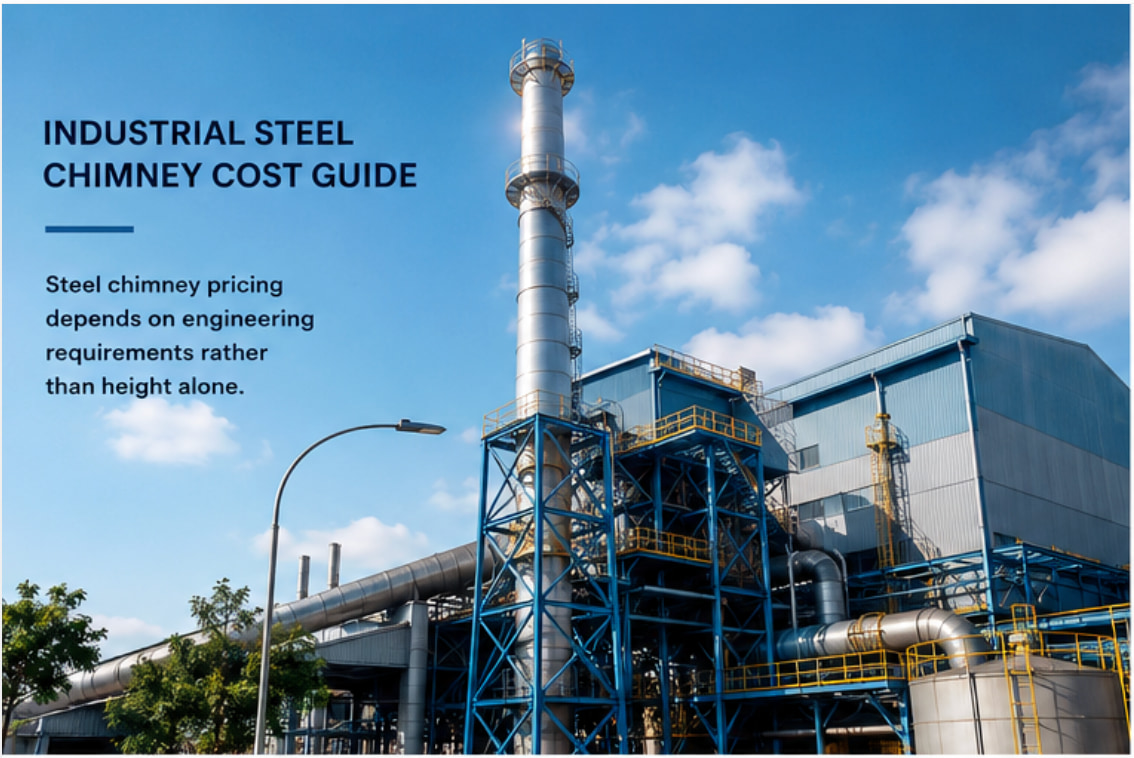
The cost of a steel chimney depends on height, diameter, material, liner configuration, environmental loads, fabrication scope, transportation, and installation. Because industrial chimneys are engineered for individual projects, accurate pricing requires project-specific technical information rather than standard price lists.
When planning an industrial project, one of the first questions raised during budgeting is, "How much will the steel chimney cost?" Unfortunately, there is no standard answer.
Unlike standardized equipment, every industrial steel chimney is engineered to match a specific combination of process conditions, structural requirements, environmental loads, and regulatory standards. Two chimneys with the same height may require completely different materials, liner systems, structural reinforcements, or corrosion protection measures, leading to significant differences in project cost.
This is why experienced EPC contractors rarely compare quotations using height alone. Instead, they evaluate the engineering assumptions behind each proposal, including material selection, operating conditions, fabrication scope, installation requirements, and expected service life.
For procurement teams, understanding what drives the price is often more valuable than knowing the price itself. It helps avoid unrealistic budget expectations, improves quotation comparisons, and supports better investment decisions throughout the project lifecycle.
This guide explains how industrial steel chimney costs are determined, which engineering factors have the greatest impact on pricing, and how EPC teams can evaluate quotations more effectively.
One of the most common questions during procurement is why quotations from different suppliers sometimes differ by 30% or more for what appears to be the same steel chimney.
The reason is simple: industrial chimneys are engineered systems rather than standard products.
Dimensions such as height and diameter are only part of the overall design. Every quotation also reflects structural calculations, material specifications, liner configuration, corrosion protection, transportation requirements, fabrication complexity, and compliance with applicable design standards.
Consider two self-supporting steel chimneys, each 60 metres high.
The first is designed for a natural gas boiler operating under stable conditions.
The second serves a hazardous waste incinerator with highly corrosive flue gases and is installed in a coastal region subject to high wind speeds.
Although the visible dimensions may be similar, the engineering requirements are completely different.
The second project may require:
A duplex stainless steel liner instead of carbon steel.
Increased insulation to control acid dew point corrosion.
Additional shell thickness to satisfy structural calculations.
Higher-grade protective coatings.
More extensive fabrication and quality inspections.
Each of these decisions influences both the initial project budget and the expected service life.
Rather than asking "Why is this quotation more expensive?", a more useful question is:
"What engineering requirements are included in this quotation that may not be included in another?"
This simple shift in perspective often explains the majority of price differences between suppliers.
Price is determined by a combination of engineering decisions rather than by a single specification. Understanding these variables allows buyers to compare quotations more effectively and identify where additional investment creates genuine long-term value.
Height is usually the first parameter considered because it directly affects the amount of structural steel required.
As height increases, the chimney generally requires:
Larger structural sections.
Increased shell thickness.
Stronger foundations.
More robust anchor bolt systems.
Greater resistance to wind and seismic loads.
However, height alone rarely determines the final quotation. A shorter chimney operating in an aggressive chemical environment may cost considerably more than a taller chimney handling relatively clean exhaust gases.
Material selection often has the greatest influence on lifecycle cost rather than initial purchase price.
Common options include carbon steel, 304 stainless steel, 316L stainless steel, and duplex stainless steel, each suited to different operating environments.
Instead of selecting the highest-grade alloy by default, engineers evaluate:
Flue gas composition.
Operating temperature.
Corrosion risk.
Design life.
Maintenance strategy.
Matching the material to the actual service conditions usually provides the best balance between reliability and investment.
| Material | Typical Application | Relative Cost |
|---|---|---|
| Carbon Steel | General industrial exhaust | Low |
| 304 Stainless Steel | Moderate corrosion environments | Medium |
| 316L Stainless Steel | Acidic condensate environments | High |
| Duplex Stainless Steel (2205) | Waste-to-energy, chemical processing | Very High |
Buyer Decision
Choosing the lowest-cost material may reduce the initial project budget, but selecting a material that is unsuitable for the operating environment often leads to higher maintenance costs, more frequent repairs, and earlier replacement. For most industrial projects, the better question is not "Which material is cheapest?" but "Which material delivers the lowest lifecycle cost?"
For many industrial chimneys, the liner is one of the largest contributors to project cost.
A chimney handling clean exhaust gases from a gas-fired boiler may only require a relatively simple liner arrangement. In contrast, applications involving biomass combustion, waste incineration, or chemical processing often require insulated liners manufactured from corrosion-resistant stainless steel.
The choice of liner material, insulation thickness, expansion joints, and support details all influence fabrication complexity and long-term reliability.
From a procurement perspective, comparing liner specifications is just as important as comparing the outer shell material.
Environmental loads are another major pricing factor that is often overlooked during the early budgeting stage.
A steel chimney installed in a low-wind inland location requires a different structural design from one installed in a coastal region or an area with high seismic activity.
Higher design loads may require:
Thicker shell plates
Larger base plates
Additional stiffeners
Stronger anchor bolts
More robust foundation connections
These requirements increase both material consumption and fabrication effort, even when the chimney dimensions remain unchanged.
Designing for higher wind or seismic loads increases the initial investment, but underestimating these loads can lead to costly structural modifications, project delays, or reduced operational safety after installation.
The external surface protection system also contributes to overall project cost.
For industrial chimneys operating in coastal environments, chemical plants, or areas with high humidity, protective coating systems play an important role in extending service life.
Rather than selecting coatings based solely on initial price, engineers typically consider:
Environmental exposure
Expected maintenance intervals
Required design life
Inspection accessibility
A higher-performance coating system may increase the fabrication cost, but it can significantly reduce repainting frequency and maintenance expenditure over the operating life of the chimney.
Transportation is frequently underestimated during budget planning.
Industrial steel chimneys are usually manufactured in multiple sections before being transported to site for assembly.
Transportation costs depend on factors such as:
Section dimensions
Total shipment weight
Export packaging
Shipping distance
Local transport restrictions
Installation costs are influenced by:
Crane capacity
Site accessibility
Lifting methodology
Available working space
Project schedule
These items should always be reviewed as part of the total project cost rather than being treated as separate considerations.
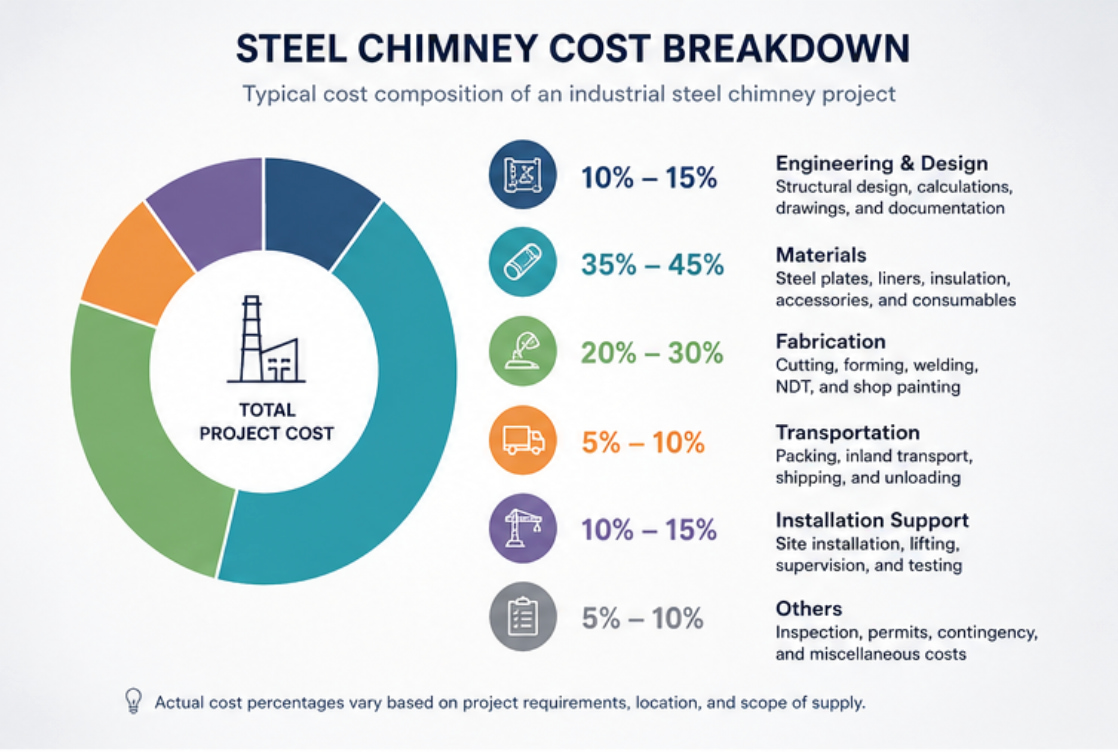
When comparing quotations, remember that steel chimney cost is driven by engineering requirements—not by height alone.
If two suppliers propose significantly different prices, ask them to explain the differences in material selection, structural design, liner configuration, corrosion protection, and project scope before making a decision.
Many buyers request a price "per metre" when preparing an initial budget. While this approach may be suitable for simple construction materials, it rarely provides meaningful guidance for industrial steel chimneys.
A more practical approach is to estimate the investment level based on project complexity.
| Project Type | Typical Budget Level | Key Cost Drivers |
|---|---|---|
| Commercial boiler chimney | Low | Height, installation |
| Industrial boiler chimney | Medium | Diameter, liner, structural design |
| Biomass or CHP chimney | Medium–High | Insulation, corrosion protection |
| Waste-to-Energy chimney | High | Duplex liner, corrosion-resistant materials, emissions requirements |
| Multi-flue industrial chimney | Very High | Multiple liners, structural complexity, fabrication |
Budget Guidance
These categories are intended only for preliminary budgeting and project planning. Final quotations should always be based on project-specific engineering requirements, applicable design standards, and installation conditions.
Fabrication cost is only one part of the total investment. During project execution, several additional costs may influence the final budget.
As chimney height and wind loads increase, foundation requirements also become more demanding.
Although foundation work is usually managed by the EPC contractor rather than the chimney manufacturer, it should be considered during the early budgeting stage.
Installation costs vary significantly depending on site conditions.
Projects with restricted access, limited crane capacity, or tight construction schedules often require more detailed lifting and installation planning.
Maintenance is sometimes overlooked because it occurs after project completion.
However, features such as inspection platforms, access doors, replaceable liners, and effective drainage systems can substantially reduce maintenance effort throughout the chimney's operating life.
A quotation that appears 10% lower today may become the more expensive option over the next twenty years if it results in higher maintenance costs, more frequent shutdowns, or earlier liner replacement.
Evaluating Total Cost of Ownership (TCO) rather than purchase price alone usually provides a better basis for long-term investment decisions.
Differences in liner materials, engineering calculations, corrosion protection systems, transportation, installation responsibilities, or warranty terms can significantly influence both project cost and long-term performance.
Comparing quotations without aligning these assumptions often leads to misleading conclusions.
Receiving several quotations is a normal part of the procurement process. The challenge is deciding which proposal offers the best value.
Comparing quotations based only on total price can be misleading because suppliers may use different materials, engineering assumptions, delivery scopes, or installation responsibilities.
A structured comparison makes it easier to identify these differences before a purchasing decision is made.
Before comparing prices, confirm that every quotation is based on the same project requirements.
Key items include:
Chimney height and diameter
Material grade
Liner configuration
Design temperature
Wind and seismic criteria
Applicable design standards
Surface protection system
Delivery scope
Installation responsibilities
If these assumptions are different, the quotations are not directly comparable.
Industrial chimneys should be designed in accordance with recognised engineering standards and local regulations.
When reviewing proposals, check whether the supplier clearly identifies the applicable design code and engineering basis.
This not only demonstrates technical capability but also reduces the risk of design changes during project execution.
The lowest quotation is not always the most economical solution.
Questions worth asking include:
Will the selected material meet the expected service life?
Is future liner replacement considered?
Will inspection and maintenance be straightforward?
Does the design minimise downtime during future maintenance?
Looking beyond the purchase price often results in lower operating costs over the lifetime of the facility.
| Evaluation Item | Why It Matters |
|---|---|
| Material specification | Determines corrosion resistance and service life |
| Design standard | Confirms engineering compliance |
| Liner configuration | Influences maintenance and replacement costs |
| Wind and seismic design | Ensures structural safety |
| Surface protection | Affects long-term durability |
| Transportation scope | Prevents unexpected logistics costs |
| Installation support | Reduces site risks and delays |
| Warranty and documentation | Supports future maintenance and asset management |
Buyer Decision
If two quotations differ significantly in price, compare the engineering scope before comparing the numbers. A lower price may reflect a reduced scope rather than a more competitive solution.
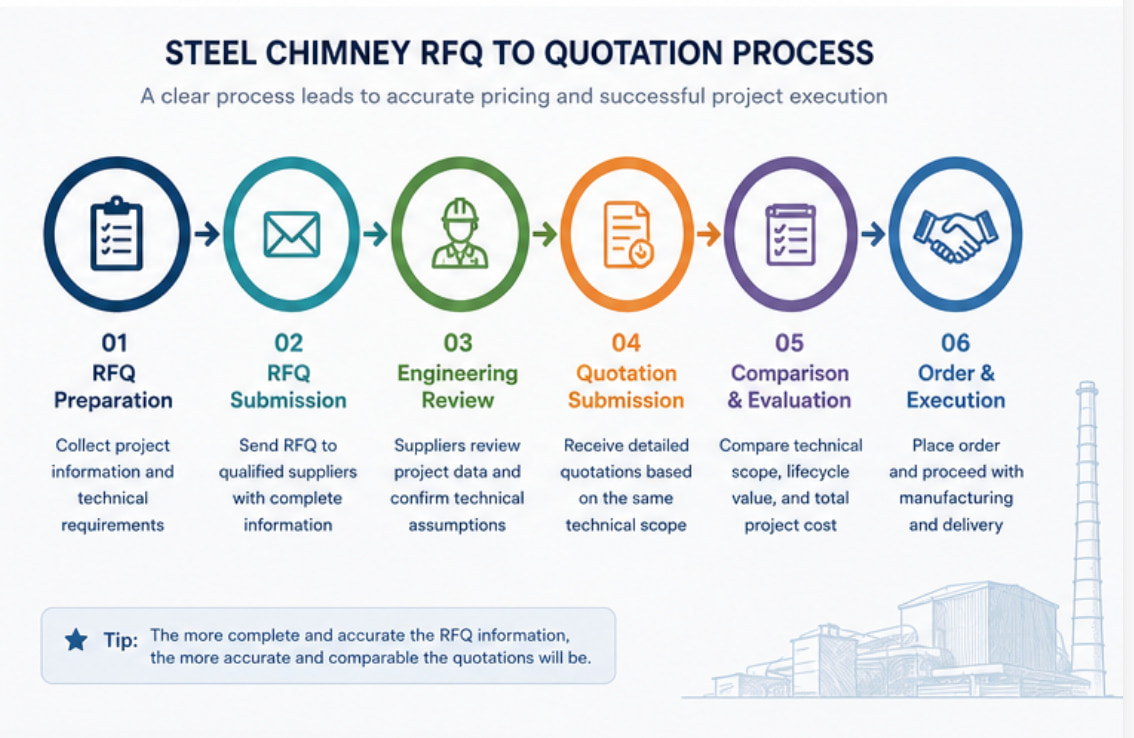
Accurate quotations begin with accurate project information.
Providing complete technical details allows suppliers to prepare proposals that are easier to evaluate and reduces the need for repeated design revisions.
Before requesting a quotation, prepare the following information whenever possible:
Required chimney height
Internal diameter
Number of flues or liners
Fuel type
Flue gas temperature
Flue gas composition (if available)
Project location
Wind speed and seismic requirements (or applicable local code)
Preferred material (if specified)
Required design standard
Expected delivery schedule
Scope of supply (fabrication only or supply + installation support)
The more complete the project information, the more accurate and comparable supplier quotations will be.
For industrial chimney projects, pricing is closely linked to engineering decisions. Rainbow works with EPC contractors, consulting engineers, and industrial clients during the early planning stage to review operating conditions, structural requirements, applicable design standards, transportation constraints, and maintenance objectives before preparing a quotation. This engineering-first approach helps clients compare solutions based on long-term value rather than initial cost alone, supporting more predictable budgets and reliable project delivery.
Comparing quotations with different technical scopes.
Selecting materials based only on initial price.
Ignoring transportation and installation costs.
Overlooking future maintenance requirements.
Requesting quotations without sufficient technical data.
Industrial steel chimneys are custom-engineered for each project, so there is no universal price. Final cost depends on factors such as height, diameter, material selection, liner configuration, structural design, and installation scope.
Generally, yes, because taller chimneys require more structural steel and stronger foundations. However, material selection and corrosion protection can sometimes have a greater impact on the overall project cost than height alone.
Not in every application. Stainless steel provides excellent corrosion resistance, but the appropriate material should always be selected according to flue gas composition, operating temperature, and expected service life.
Different quotations may include different engineering assumptions, material grades, coating systems, delivery scopes, or installation services. Always compare the technical scope before comparing prices.
Depending on the supplier, a quotation may include engineering design, fabrication, surface treatment, documentation, transportation, installation support, and inspection requirements. Always confirm the exact scope before making a decision.
Providing complete RFQ information, selecting materials based on actual operating conditions, and evaluating lifecycle cost rather than purchase price alone are among the most effective ways to optimise project value.
At a minimum, suppliers should know the required height, diameter, fuel type, operating temperature, project location, applicable design standards, and installation requirements.
Service life depends on material selection, operating environment, corrosion protection, and maintenance practices. A properly designed and maintained steel chimney can remain in service for several decades.
Whether your project is still in the feasibility stage or ready for procurement, an engineering review can often identify opportunities to optimise cost before fabrication begins. Rainbow supports industrial and EPC projects with preliminary budget evaluations, material recommendations, structural design assistance, and quotation support based on project-specific operating conditions and applicable standards. This collaborative approach helps clients make informed decisions while balancing performance, compliance, and long-term value.

Wang Yong
Chairman
"True progress rises when industry respects the sky it touches."