What are you looking for?

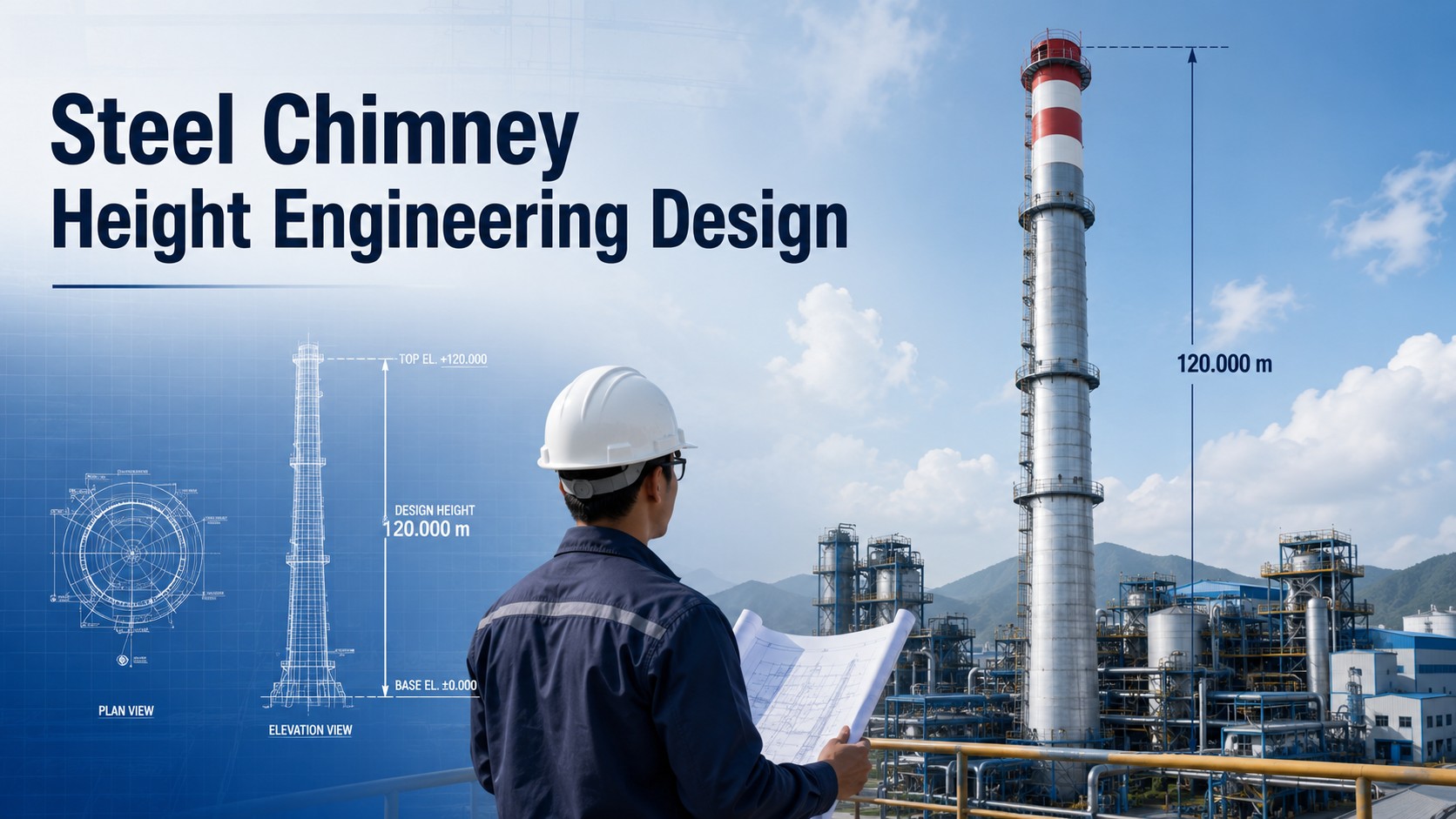
Steel chimney height is determined through engineering analysis rather than a fixed formula. Engineers evaluate flue gas characteristics, draft requirements, emission dispersion, wind loads, surrounding structures, and applicable standards such as ASME STS-1, EN 13084, and CICIND. An optimized chimney height ensures environmental compliance, operational efficiency, structural safety, and long-term lifecycle value.
There is no universal steel chimney height suitable for every project.
Chimney height should balance environmental compliance, draft performance, structural safety, and project cost.
International standards provide design guidance, but every project requires site-specific engineering calculations.
Modern projects often combine engineering calculations with atmospheric dispersion modeling and CFD analysis.
Optimizing chimney height during the FEED stage helps reduce redesign, construction costs, and operational risks.
Stainless steel chimneys are critical components of industrial facilities, safely discharging flue gases while supporting efficient plant operation and environmental compliance. Whether serving a power plant, industrial boiler, waste incineration facility, chemical plant, or manufacturing process, the chimney's height directly affects emission dispersion, natural draft, structural stability, and overall project economics.
One of the most common misconceptions is that a taller chimney always delivers better performance. In reality, unnecessarily increasing stack height raises fabrication costs, foundation requirements, transportation complexity, and maintenance expenses without guaranteeing improved environmental performance. Conversely, a chimney that is too short may fail to generate adequate draft, increase ground-level pollutant concentrations, or violate environmental regulations.
Because every industrial process operates under different conditions, steel chimney height calculation is an engineering optimization process rather than a standard selection exercise. Engineers must evaluate multiple variables—including flue gas temperature, exhaust flow rate, atmospheric conditions, wind loading, surrounding structures, and applicable design codes—to determine the most appropriate solution.
This guide explains the engineering principles behind steel chimney height calculation, the factors that influence design, commonly used calculation methods, relevant international standards, and practical recommendations that help engineers and EPC contractors make informed decisions.
Selecting the correct steel chimney height influences far more than regulatory compliance. It affects plant efficiency, structural reliability, maintenance costs, and the long-term success of the entire project.
Rather than designing for the tallest possible stack, experienced engineers seek the optimum height—one that satisfies operational, environmental, and structural requirements while minimizing lifecycle costs.
The primary function of an industrial chimney is to disperse combustion gases safely into the atmosphere.
Environmental authorities regulate pollutant concentrations at ground level instead of prescribing a fixed chimney height. As a result, engineers must verify that the proposed stack can adequately disperse pollutants such as:
Sulfur dioxide (SO₂)
Nitrogen oxides (NOₓ)
Particulate matter (PM)
Volatile organic compounds (VOCs)
Dispersion performance depends on several variables, including flue gas temperature, exhaust velocity, local wind conditions, atmospheric stability, and surrounding terrain. Modern projects frequently use atmospheric dispersion modeling to validate compliance before construction begins.
Engineering Tip
Two facilities with identical production capacities may require completely different chimney heights because of differences in meteorological conditions, surrounding buildings, and local environmental regulations.
Steel chimney height also has a direct impact on plant performance.
For boilers and industrial furnaces, chimney height influences natural draft, which helps transport combustion gases through the exhaust system. Insufficient draft may result in unstable combustion, higher fuel consumption, or reduced equipment efficiency.
Generator exhaust systems, on the other hand, are particularly sensitive to back pressure. In these applications, engineers optimize chimney height together with stack diameter and exhaust velocity to achieve reliable engine performance without unnecessary structural cost.
Because draft performance varies by application, chimney height should always be evaluated as part of the complete exhaust system rather than as an isolated design parameter.
As chimney height increases, structural design becomes significantly more challenging.
Tall steel chimneys must safely withstand:
Wind loads
Seismic forces
Thermal expansion
Dynamic vibration
Fatigue loading
Among these, wind-induced vibration is one of the most critical considerations for slender steel stacks. Phenomena such as vortex shedding can create cyclic stresses that shorten structural service life if not properly addressed.
To ensure long-term reliability, engineers evaluate structural behavior according to recognized standards such as ASME STS-1 and EN 13084, incorporating appropriate stiffening systems, expansion joints, and vibration-control measures where required.
A taller chimney is not always a better investment.
Increasing stack height generally leads to:
| Taller Chimney | Project Impact |
|---|---|
| More structural steel | Higher fabrication cost |
| Larger foundations | Increased civil engineering work |
| Heavier lifting equipment | Longer installation time |
| Greater inspection area | Higher maintenance costs |
| Larger wind loads | More complex structural analysis |
The objective is therefore to identify the most economical engineering solution over the entire service life, rather than simply minimizing initial construction cost.
During the FEED (Front-End Engineering Design) stage, EPC contractors typically evaluate several design alternatives to achieve the optimum balance between environmental compliance, structural safety, operational efficiency, constructability, and lifecycle value.
Expert Insight
Steel chimney height should never be selected using a standard industry value. Every project requires an integrated engineering assessment that combines process design, environmental analysis, structural calculations, and long-term operational planning. Optimizing these factors early significantly reduces project risks and avoids costly modifications after construction.
Determining the optimum steel chimney height requires balancing environmental performance, process requirements, structural safety, and economic feasibility. Instead of relying on a single equation, engineers evaluate multiple variables that interact throughout the chimney's lifecycle.
The following factors have the greatest influence on steel chimney height calculations.
Flue gas properties are among the first parameters engineers evaluate because they directly affect natural draft, pollutant dispersion, and material selection.
Important design inputs include:
Flue gas temperature
Exhaust flow rate
Gas velocity
Pollutant composition
Moisture content
Operating pressure
Higher flue gas temperatures generally improve buoyancy and natural draft, allowing pollutants to disperse more effectively. However, higher temperatures also increase thermal expansion and may require enhanced insulation or specialized liner materials.
Similarly, flue gas composition influences corrosion resistance requirements. Facilities handling acidic or highly corrosive exhaust gases often require stainless steel or duplex stainless steel liners to maintain long-term reliability.
Environmental compliance is often the primary driver of chimney height selection.
Rather than specifying a universal stack height, regulatory authorities require industrial facilities to meet allowable ground-level pollutant concentrations.
Typical regulatory considerations include:
National emission standards
Local environmental regulations
Environmental Impact Assessment (EIA) requirements
Industry-specific permits
Air quality management zones
To demonstrate compliance, engineers commonly perform atmospheric dispersion modeling that evaluates how pollutants behave under site-specific operating and meteorological conditions.
Engineering Tip
Selecting a chimney height solely because it meets a minimum regulatory requirement may not provide adequate environmental performance under actual operating conditions. Engineering verification is always recommended.
Weather conditions significantly influence chimney performance.
Engineers analyze:
Prevailing wind direction
Wind speed
Atmospheric stability
Ambient temperature
Terrain roughness
Seasonal weather patterns
For facilities located near coastlines, mountains, or densely developed industrial zones, local airflow may differ considerably from standard assumptions.
In these situations, Computational Fluid Dynamics (CFD) or wind tunnel studies can improve design accuracy and reduce project risk.
Nearby buildings and equipment can substantially influence effective chimney performance.
Tall structures may create:
Building downwash
Turbulence
Air recirculation
Reduced pollutant dispersion
Common sources of aerodynamic interference include:
Boiler houses
Cooling towers
Storage tanks
Process buildings
Steel structures
During the FEED stage, engineers evaluate the entire plant layout rather than designing the chimney as an isolated structure.
Different industrial processes require different chimney performance characteristics.
| Application | Primary Design Focus |
|---|---|
| Boiler Chimney | Natural draft and combustion efficiency |
| Generator Exhaust Stack | Engine back pressure control |
| Waste Incineration Chimney | Corrosion resistance and emission dispersion |
| Power Plant Chimney | High-volume exhaust and structural dynamics |
| Chemical Plant Chimney | Hazardous gas handling and environmental compliance |
| Cement Plant Chimney | Dust dispersion and continuous operation |
Each application requires project-specific engineering analysis. A chimney height suitable for a biomass boiler may not be appropriate for a waste-to-energy facility or a diesel generator system.
As chimney height increases, structural forces increase significantly.
Key structural considerations include:
Wind loading
Seismic loading
Dead load
Thermal stress
Fatigue loading
Dynamic response
Foundation behavior
For taller chimneys, engineers also evaluate vortex shedding and resonance effects to ensure long-term structural reliability.
Industrial facilities frequently expand production capacity during their service life.
Designers should consider whether future upgrades may require:
Increased flue gas volume
Higher operating temperatures
Additional process equipment
Stricter emission requirements
Designing only for current operating conditions can lead to expensive modifications later. Where practical, engineers should evaluate reasonable future operating scenarios during the initial design phase.
The following matrix summarizes how different engineering factors influence chimney height decisions.
| Design Factor | Influence on Height | Engineering Priority |
| Flue gas temperature | High | ★★★★★ |
| Emission regulations | High | ★★★★★ |
| Draft requirements | High | ★★★★★ |
| Wind load | High | ★★★★★ |
| Surrounding buildings | Medium–High | ★★★★☆ |
| Structural stability | High | ★★★★★ |
| Future expansion | Medium | ★★★★☆ |
| Construction budget | Medium | ★★★★☆ |
Key Takeaway: No single parameter determines the final steel chimney height. Successful designs integrate process engineering, environmental compliance, structural analysis, and long-term operational planning.
Industrial chimney height is typically determined using a combination of engineering methods rather than relying on a single calculation. The complexity of the project dictates the level of analysis required.
During the concept or FEED stage, engineers may use empirical guidelines or regulatory recommendations to establish an initial height range.
This approach is useful for:
Budget estimation
Preliminary equipment layouts
Early feasibility studies
However, preliminary values should always be verified through detailed engineering before final design approval.
This is the most widely used approach for industrial chimney design.
Engineers evaluate:
Required draft
Exhaust gas temperature
Flow rate
Pressure loss
Chimney diameter
Material properties
Structural loading
Several iterations are often required before identifying the optimum balance between operational performance, environmental compliance, and construction cost.
Dispersion modeling predicts how pollutants travel after leaving the chimney.
Common tools include:
AERMOD
CALPUFF
Gaussian Plume Models
This method is particularly valuable for:
Waste incineration plants
Chemical facilities
Thermal power plants
Large manufacturing complexes
Because dispersion depends on both chimney height and exhaust characteristics, modeling frequently identifies more efficient solutions than simply increasing stack height.
For complex industrial sites, CFD provides detailed simulations of airflow around buildings and process equipment.
CFD analysis can evaluate:
Building downwash
Wind interference
Turbulence
Pollutant dispersion
Temperature distribution
Although CFD requires additional engineering effort, it is increasingly used in large EPC projects to improve design confidence.
Expert Insight
Modern steel chimney design rarely depends on a single calculation method. The most reliable solutions combine engineering calculations, atmospheric dispersion modeling, and structural analysis to achieve safe, compliant, and cost-effective performance.
Before confirming the final chimney height, engineers should verify that the following questions have been answered:
Have all process operating conditions been confirmed?
Has the required draft been calculated?
Have emission dispersion requirements been verified?
Have wind and seismic loads been evaluated?
Has thermal expansion been considered?
Have applicable design standards been applied?
Has future plant expansion been assessed?
Has the overall lifecycle cost been optimized?
Completing this checklist helps ensure that the selected steel chimney height is based on comprehensive engineering analysis rather than simplified assumptions.
Industrial steel chimney height should always be determined in accordance with recognized engineering standards and applicable environmental regulations. These documents establish the design framework for structural safety, operational performance, and regulatory compliance.
The most frequently referenced standards include:
| Standard | Primary Focus | Typical Application |
|---|---|---|
| ASME STS-1 | Structural design of steel stacks | Industrial boilers, manufacturing plants, power facilities |
| CICIND Model Code | Comprehensive industrial chimney engineering | International EPC projects |
| EN 13084 | Free-standing industrial chimneys | European industrial facilities |
| ASCE 7 | Wind and seismic loading | Structural analysis |
| Local Environmental Regulations | Air quality and emission compliance | All industrial projects |
These standards complement rather than replace one another. A successful chimney design combines structural requirements with project-specific environmental analysis to determine the optimum stack height.
Engineering Tip
Compliance with international design standards does not automatically guarantee environmental compliance. Structural analysis and emission dispersion studies should always be evaluated together.
Industrial chimney height is typically determined through an iterative engineering workflow rather than a single calculation.
Gather the operating conditions that define the exhaust system, including:
Fuel type
Heat input
Flue gas temperature
Exhaust flow rate
Pollutant composition
Operating pressure
Ambient conditions
Accurate process data forms the foundation of every reliable chimney design.
Determine the draft needed to overcome pressure losses while maintaining stable equipment operation.
Key considerations include:
Natural draft
Pressure loss
Stack diameter
Gas density
Temperature difference
For generator exhaust systems, engine back pressure limits should also be verified.
Evaluate whether the proposed chimney height can safely disperse pollutants under expected operating conditions.
Depending on project complexity, engineers may use:
Gaussian plume calculations
AERMOD
CALPUFF
CFD analysis
The objective is to satisfy environmental regulations while avoiding unnecessary structural height.
Once a preliminary height is established, engineers verify structural integrity by evaluating:
Wind loads
Seismic loads
Dynamic response
Thermal expansion
Foundation loads
Fatigue performance
If structural demands become excessive, the chimney configuration may be optimized by adjusting height, diameter, wall thickness, or support systems.
The final stage combines process engineering, environmental analysis, and structural calculations to determine the optimum chimney height.
The completed engineering package typically includes:
General arrangement drawings
Structural calculations
Material specifications
Inspection requirements
Maintenance recommendations
This integrated approach reduces project risks and improves long-term operational reliability.
Successful steel chimney projects are rarely the result of a single calculation. They are the outcome of coordinated engineering decisions made throughout the design process.
The following best practices help engineers avoid common design issues.
| Best Practice | Why It Matters |
| Evaluate chimney height during the FEED stage | Reduces redesign during EPC execution |
| Combine draft calculations with dispersion modeling | Improves environmental and operational performance |
| Analyze surrounding structures | Minimizes building downwash effects |
| Consider thermal expansion early | Prevents long-term structural stress |
| Select materials based on flue gas chemistry | Extends service life and reduces maintenance |
| Plan for future plant expansion | Avoids expensive modifications after commissioning |
Conversely, common design mistakes include selecting chimney height based solely on previous projects, ignoring site-specific meteorological conditions, underestimating wind-induced vibration, or choosing materials primarily on initial cost rather than lifecycle performance.
Expert Insight
The optimum steel chimney height is not the tallest or the lowest design. It is the height that delivers regulatory compliance, reliable operation, structural safety, and the best lifecycle value for a specific industrial application.
The table below provides typical preliminary height ranges used during conceptual design. These values are for reference only and should always be confirmed through detailed engineering calculations.
| Industry | Typical Preliminary Height* | Primary Design Considerations |
| Industrial Boiler | 20–60 m | Draft performance and emissions |
| Generator Exhaust System | 10–40 m | Back pressure and noise control |
| Chemical Plant | 30–80 m | Corrosion resistance and hazardous gases |
| Waste Incineration Plant | 40–100+ m | Emission dispersion and corrosion protection |
| Waste-to-Energy Plant | 60–150+ m | Large flue gas volume and environmental compliance |
| Cement Plant | 50–120 m | Dust control and continuous operation |
| Biomass Plant | 40–100 m | Moisture management and combustion efficiency |
| Thermal Power Plant | 100–250+ m | Structural dynamics and high-capacity exhaust |
*Actual chimney height depends on engineering calculations, local regulations, process conditions, and site-specific environmental factors.
Steel chimney height is one of the most influential design parameters in any industrial exhaust system. It directly affects environmental compliance, combustion efficiency, structural reliability, maintenance requirements, and overall project cost.
Rather than relying on fixed values or previous projects, engineers should determine chimney height through a comprehensive evaluation of flue gas characteristics, draft requirements, atmospheric dispersion, structural loading, and applicable international standards.
By integrating process engineering, environmental analysis, and structural design during the early stages of project development, EPC contractors and industrial plant owners can optimize chimney performance, reduce lifecycle costs, and improve long-term operational reliability.
Steel chimney height is determined using engineering calculations that evaluate flue gas characteristics, draft requirements, atmospheric dispersion, structural loading, and applicable design standards. Most industrial projects combine analytical calculations with environmental modeling to optimize performance.
There is no universal minimum height. The required height depends on equipment type, environmental regulations, surrounding structures, operating conditions, and project-specific engineering analysis.
Common standards include ASME STS-1, CICIND Model Code, EN 13084, ASCE 7 for structural loading, and local environmental regulations governing emission dispersion.
Yes. Diameter influences exhaust velocity, pressure loss, and draft performance. Engineers optimize both dimensions together rather than designing them independently.
Dispersion modeling predicts ground-level pollutant concentrations under different operating and weather conditions, helping engineers verify environmental compliance before construction.
CFD is recommended for complex industrial sites where surrounding buildings, terrain, or unusual airflow patterns could significantly influence pollutant dispersion or structural loading.
Typical inputs include fuel type, flue gas temperature, flow rate, pollutant composition, meteorological data, surrounding structures, applicable standards, and structural loading criteria.
Early evaluation enables EPC teams to coordinate process, structural, environmental, and construction requirements, reducing redesign, controlling costs, and improving project execution.
Rainbow's engineering team provides customized steel chimney design based on your operating conditions, environmental requirements, and applicable international standards. Contact us to discuss your project requirements or request a preliminary engineering evaluation.

Wang Yong
Chairman
"True progress rises when industry respects the sky it touches."