What are you looking for?

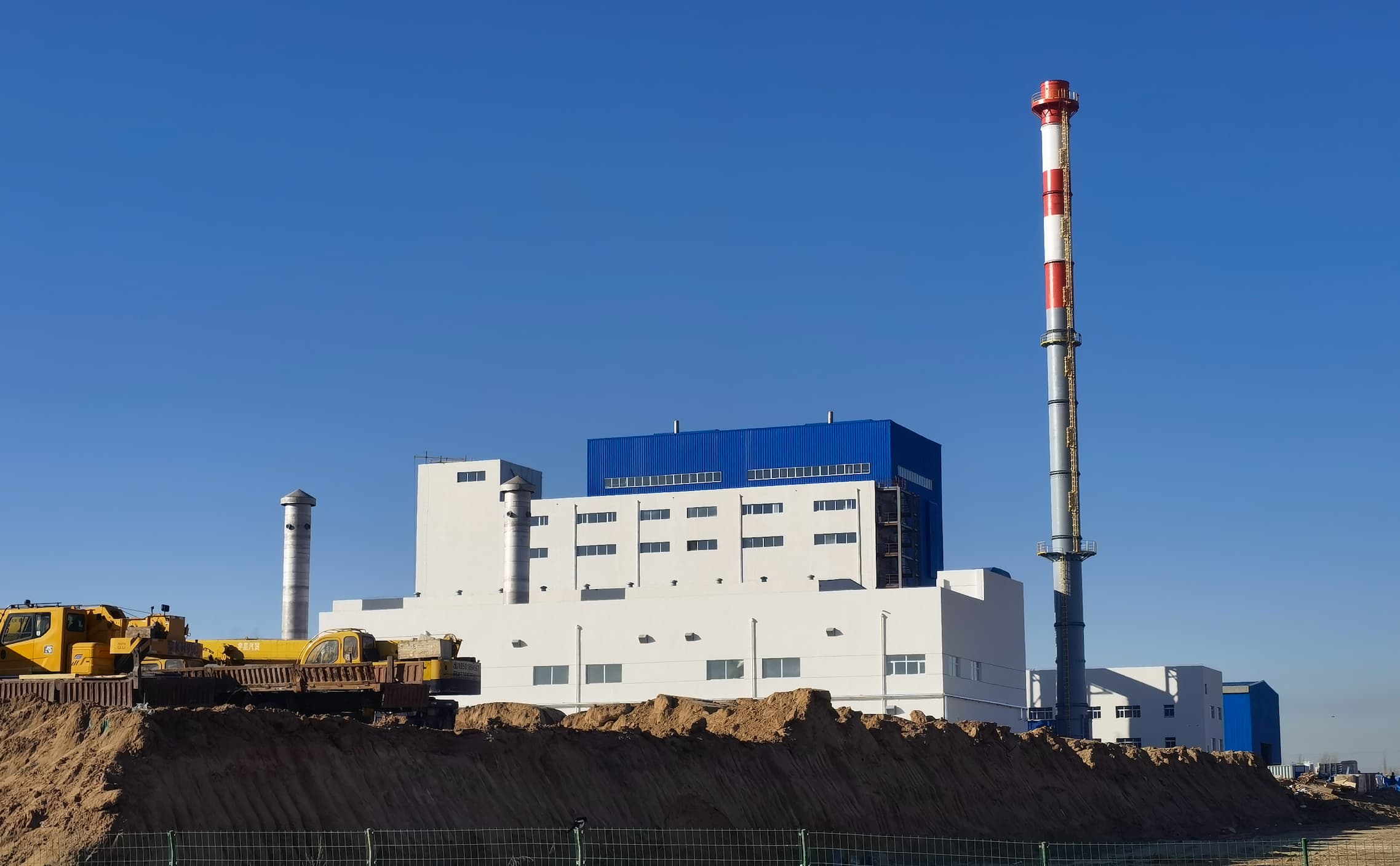
A steel chimney is a critical vertical exhaust structure used in industrial facilities to safely discharge flue gas, control emissions, and maintain efficient combustion in energy and manufacturing systems. In modern infrastructure, an industrial steel chimney is widely used in thermal power plants, boiler plants, cement production lines, steel mills, and chemical processing facilities.
A steel chimney system is engineered using structural steel, corrosion-resistant coatings, and internal liners such as refractory lining or flue liner systems to withstand high temperatures, corrosive gases, and dynamic wind loads.
A steel chimney (also called steel stack chimney, steel smokestack, or steel exhaust chimney) is an engineered vertical structure designed to release combustion by-products at a safe elevation while ensuring compliance with steel chimney regulations and environmental emission standards.
The primary purpose of a steel chimney includes:
Safe discharge of industrial exhaust gases
Supporting air pollution control systems
Enhancing combustion efficiency in boilers
Ensuring compliance with emission regulations
Providing stable industrial ventilation for large facilities
Key benefits of a steel chimney include:
High strength-to-weight ratio
Modular steel chimney fabrication and faster installation
Flexibility for different steel chimney types
Suitable for extreme industrial environments
Lower construction time compared to concrete chimneys
Adaptability for steel chimney for power plants and factories
Global demand for steel chimney systems has increased by more than 4–6% annually, driven by stricter environmental regulations and expansion of industrial infrastructure in Asia and the Middle East.
A steel chimney operates based on thermodynamic and fluid dynamic principles that allow combustion gases to rise naturally through a vertical shaft.
The stack effect is the core principle of how a steel chimney works. Hot gases inside the chimney are less dense than ambient air, creating upward buoyancy.
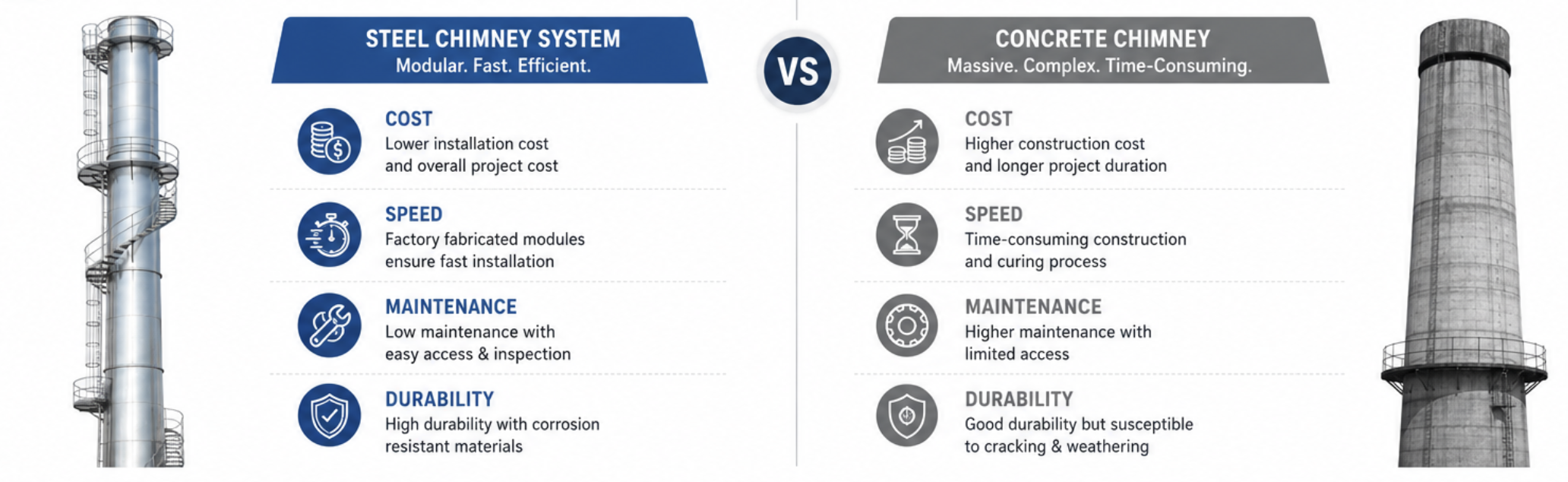
This pressure difference drives gas movement in a steel stack chimney, improving draft efficiency in a boiler plant or industrial furnace.
A properly designed steel chimney design ensures sufficient draft for combustion systems. Draft depends on:
steel chimney height
flue gas temperature
ambient air conditions
wind load effects
A taller steel chimney increases draft efficiency and reduces backpressure in industrial boilers.
The steel exhaust chimney safely releases treated or untreated flue gas after passing through pollution control systems such as:
Electrostatic precipitators
Scrubbers
Catalytic filters
This process ensures compliance with steel chimney regulations and emission standards set by environmental authorities.
A self-supporting steel chimney is a freestanding structure that relies entirely on its own structural steel shell and foundation.
Advantages:
Compact footprint
High stability
Ideal for medium-height factory chimney systems
Common in steel chimney for industrial boilers
A guyed chimney uses tension cables for stability.
Key characteristics:
Suitable for very tall stacks
Lower material cost
Requires large land area
Common in remote industrial zones
A Stainless steel chimney with double-wall insulation improves thermal performance and corrosion resistance.
Applications:
Chemical plants
Waste-to-energy systems
High-temperature exhaust environments
A multi-flue steel chimney system contains multiple internal ducts inside one structure.
Benefits:
Shared infrastructure for multiple boilers
Reduced construction cost
Centralized emission control
| Type | Structure | Cost | Application | Height Range |
|---|---|---|---|---|
| Self-supporting steel chimney | Rigid standalone | Medium | Industrial boilers | 20–120m |
| Guyed chimney | Cable-supported | Low | Remote plants | 50–300m |
| Double-wall stainless steel chimney | Insulated | High | Chemical plants | 10–80m |
| Multi-flue chimney | Multi-channel | High | Power plants | 60–200m |
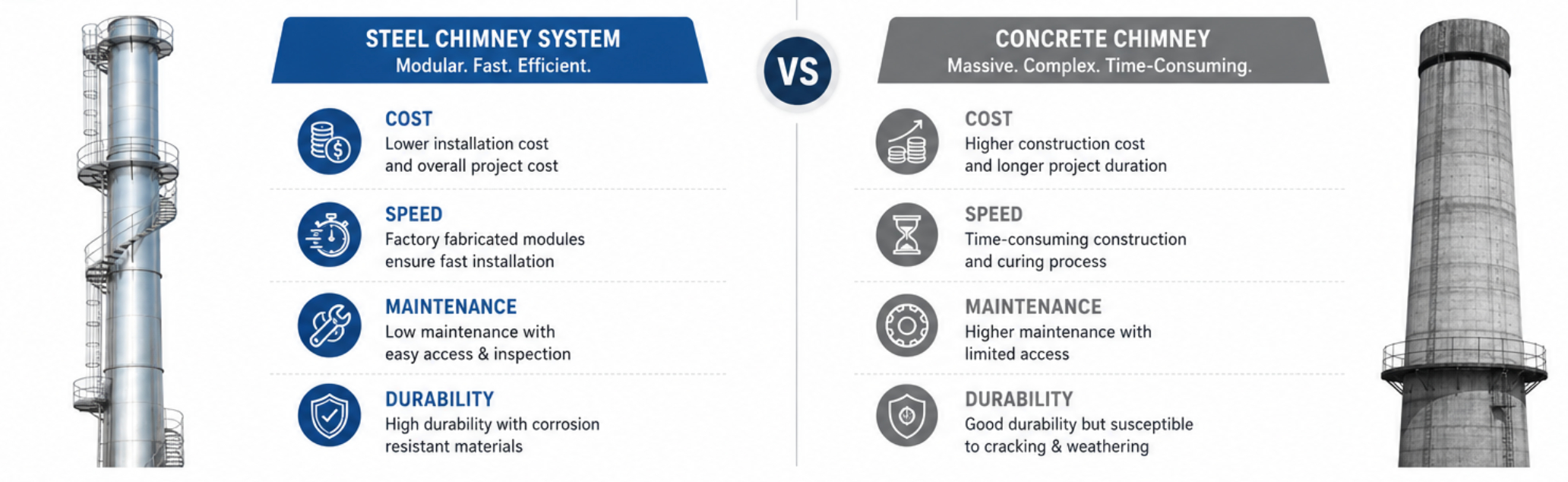
| Feature | Steel Chimney | Concrete Chimney |
|---|---|---|
| Construction speed | Fast | Slow |
| Flexibility | High | Low |
| Maintenance | Easy | Difficult |
| Cost | Moderate | High initial |
| Lifespan | 25–50 years | 40–70 years |
A steel chimney vs concrete chimney comparison shows steel is preferred for modular and rapidly deployed industrial chimney systems.
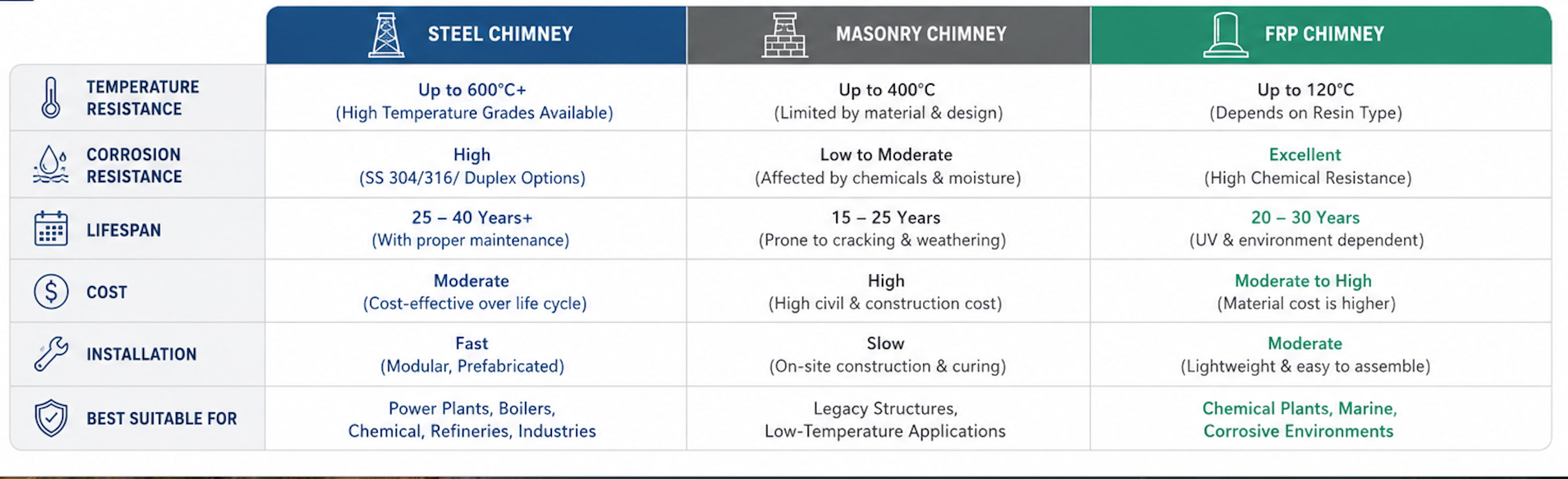
| Feature | Steel Chimney | Masonry Chimney |
|---|---|---|
| Application | Industrial | Residential/low-temp |
| Strength | High | Medium |
| Temperature resistance | Very high | Low |
| Maintenance | Moderate | High |
The Steel chimney vs. Masonry chimney comparison highlights steel dominance in modern industrial ventilation systems.
| Feature | Steel Chimney | FRP Chimney |
|---|---|---|
| Strength | High | Medium |
| Corrosion resistance | High with coating | Very high |
| Temperature resistance | Very high | Limited |
| Industrial use | Heavy industry | Light industry |
A steel chimney provides several engineering advantages:
High structural efficiency
Modular steel chimney construction
Fast steel chimney installation process
Adaptable for tall steel smokestack designs
Compatible with emissions control systems
Suitable for thermal power plants
Despite benefits, limitations exist:
Requires advanced corrosion protection methods
Periodic steel chimney maintenance checklist required
Thermal expansion stress
Higher lifecycle maintenance in acidic environments
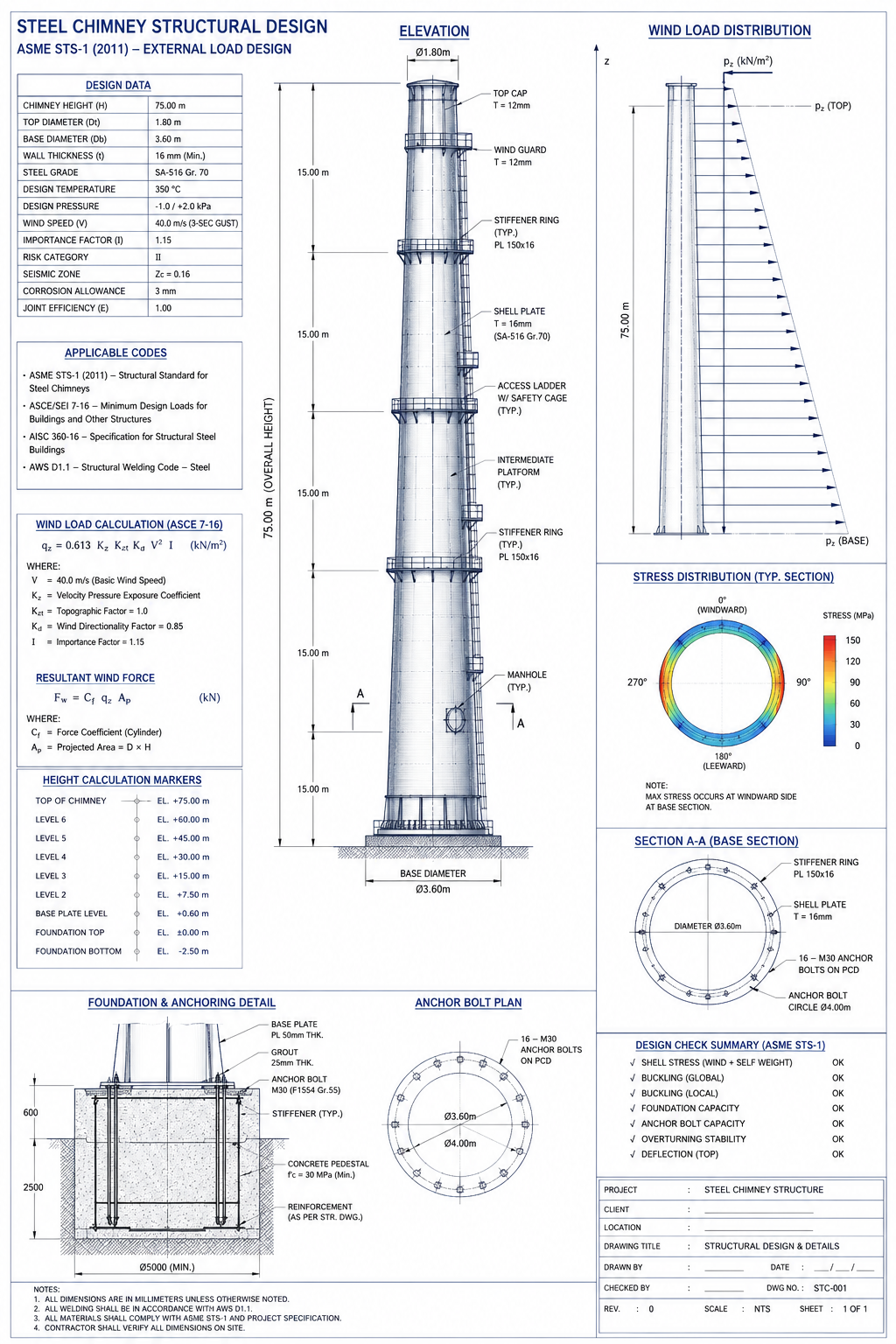
The ASME standard defines steel chimney structural design standards, including:
Wind load analysis
Thermal stress evaluation
Fatigue resistance
Eurocode EN 1993 governs steel structure safety in Europe, widely applied in steel chimney design.
Indian standard for steel chimney construction and safety compliance.
Engineering drawings include:
Elevation layout
Foundation design
Flue gas routing
Steel shell thickness diagrams
Higher stacks improve dispersion of pollutants.
Large boiler plant systems require taller chimneys.
A detailed wind load analysis ensures structural stability.
Authorities define minimum stack height based on emission output.
| Boiler Capacity | Recommended Height | Application |
|---|---|---|
| <10 MW | 20–40m | Small factory |
| 10–50 MW | 40–80m | Medium plant |
| 50–200 MW | 80–150m | Industrial plant |
| 200+ MW | 150–250m | Power plant chimney |
Uses high-grade structural steel and corrosion-resistant alloys.
Steel plates are rolled into cylindrical sections.
Precision welding ensures airtight joints in steel chimney fabrication.
Includes coatings, galvanization, and protective painting.
Non-destructive testing ensures safety and compliance.
Includes refractory lining and acid-resistant bricks.
Protects against environmental exposure.
Enhances durability of steel exhaust chimney systems.
Protects against UV, rain, and industrial chemicals.
Strong chimney foundation ensures stability.
Modular segments assembled on-site.
Cranes used for steel chimney installation process.
Structural alignment and safety checks completed.
Rainbow chimney installation project video
Weld joints
Coating condition
Structural deformation
Early detection of rust in steel stack chimney.
Wind fatigue and vibration monitoring.
Recoating, welding, or section replacement.
Higher steel chimney height calculation increases cost.
Larger diameter requires more steel.
Stainless steel increases cost significantly.
Remote areas increase logistics cost.
Advanced coatings increase total investment.
| Factor | Cost Impact |
|---|---|
| Height | High |
| Diameter | Medium |
| Material grade | High |
| Installation | Medium–High |
| Coating system | Medium |
Average ranges:
Small industrial chimney: $10,000–$60,000
Medium industrial steel chimney: $60,000–$250,000
Large power plant chimney: $250,000–$1.5M+
Used in steel chimney for power plants systems.
Common in steel chimney for industrial boilers.
Handle dust-heavy exhaust.
High-temperature metallurgical processes.
Require corrosion-resistant designs.
Advanced emission treatment systems.
Corrosion exposure
Thermal cycling
Maintenance quality
Carbon steel: 20–30 years
Stainless steel chimney: 30–50 years
Proper care increases lifespan by 25–40%.
Strong steel chimney manufacturer must provide design + simulation.
Supports large-scale steel chimney fabrication.
ISO, ASME, CE compliance.
Global steel chimney installation expertise.
Leading steel chimney manufacturer in China often exports globally.
A steel chimney is used to discharge flue gases safely from industrial systems such as boilers, furnaces, and power plants. It supports emissions control, improves combustion efficiency, and ensures compliance with environmental regulations in industrial ventilation systems.
The height of a steel chimney depends on emission levels, boiler capacity, and environmental regulations. Typical industrial stacks range from 20 meters to over 200 meters in large thermal power plants, ensuring proper dispersion of pollutants.
A steel chimney typically lasts 20–50 years depending on material, corrosion protection, and maintenance quality. Stainless steel systems last longer due to superior resistance to harsh industrial environments and chemical exposure.
The steel chimney cost varies from $10,000 to over $1 million depending on height, diameter, material grade, and installation complexity. Large power plant chimney systems require significantly higher investment due to engineering complexity.
Structural steel is widely used, but stainless steel is preferred in corrosive environments. Many systems combine refractory lining, coatings, and protective layers to extend durability and ensure safe flue gas discharge.
Key standards include ASME STS-1, Eurocode EN 1993, and IS 6533. These govern structural design, wind load analysis, thermal performance, and safety requirements for steel chimney structural design standards.
A steel chimney vs concrete chimney comparison shows steel is faster to install, more flexible, and modular. Concrete chimneys may last longer but require higher construction time and cost.
A steel chimney maintenance checklist recommends inspections every 6–12 months. High-corrosion industrial environments may require quarterly inspections to ensure safety and prevent structural degradation.
Corrosion is caused by moisture, acidic gases, temperature fluctuations, and industrial pollutants. Effective corrosion protection methods like coatings and linings significantly reduce long-term degradation.
Yes, a steel chimney system can be fully customized in height, diameter, flue configuration, and materials to meet specific industrial process requirements and emission standards.
Yes, especially when designed with refractory lining and stainless steel materials. They are widely used in high-temperature industrial environments such as boilers and furnaces.
A steel chimney design involves structural analysis, wind load calculations, emission requirements, material selection, and compliance with ASME, Eurocode, or national standards.
Maintenance includes routine inspections, corrosion monitoring, coating repair, and structural assessment. Following a steel chimney maintenance checklist ensures long-term safety and performance.
ASME STS-1 Steel Stack Design Standard – American Society of Mechanical Engineers
Eurocode EN 1993 – European Committee for Standardization
IS 6533 Code for Steel Chimneys – Bureau of Indian Standards
U.S. EPA Industrial Emission Guidelines – https://www.epa.gov
World Bank Air Quality & Industrial Emission Reports – https://www.worldbank.org

Wang Yong
Chairman
"True progress rises when industry respects the sky it touches."