What are you looking for?

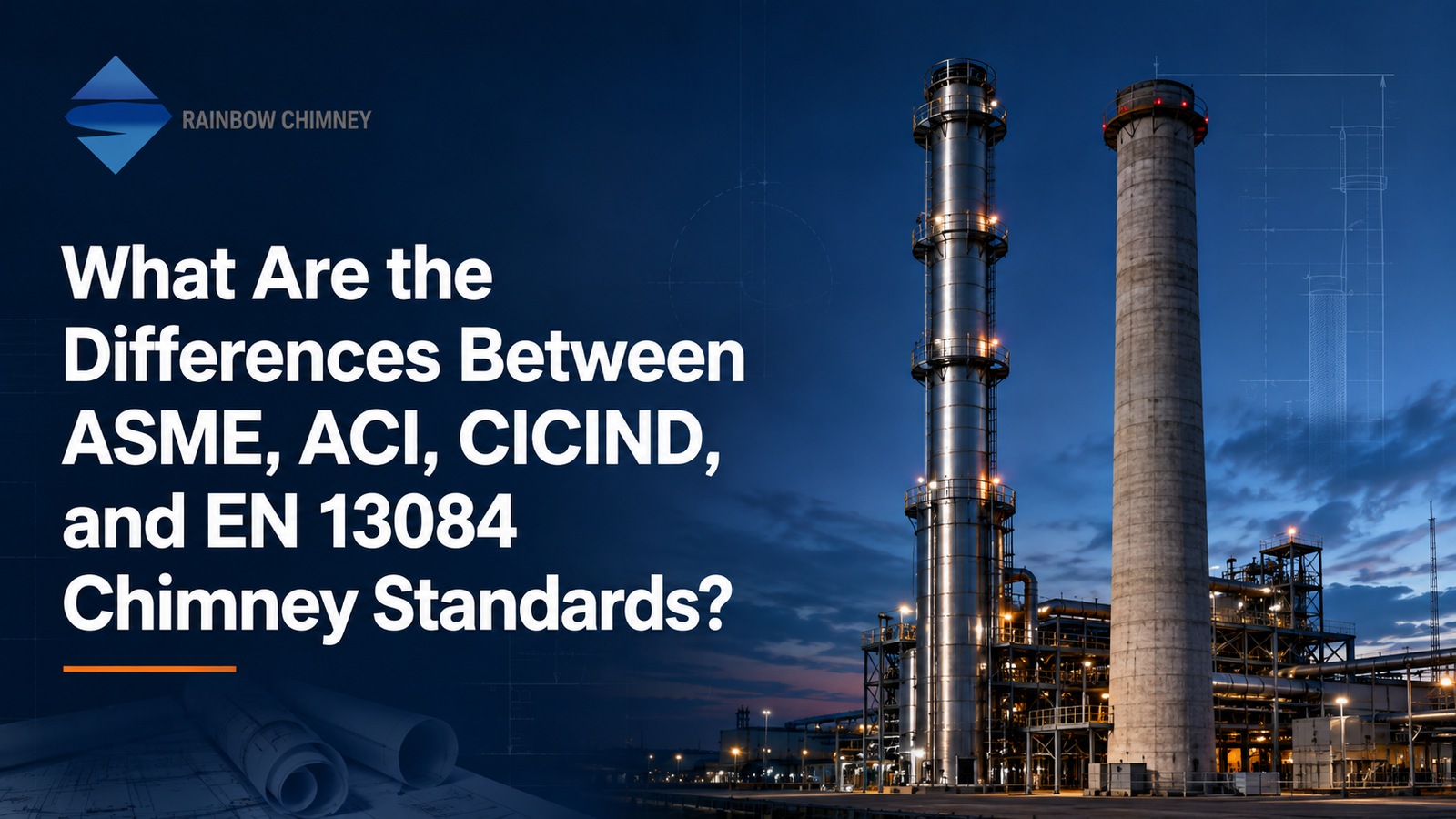
ASME STS-1 is mainly for steel stacks, ACI 307 is for reinforced concrete chimneys, CICIND provides international model codes and practical chimney guidance, and EN 13084 is a European series for structurally independent chimneys and their liners. The right document depends on the chimney material, project country, contract, and authority having jurisdiction. For projects that need code selection before detailed engineering, Rainbow can review the required design basis through its industrial chimney design standards guide.
These documents overlap, but they are not interchangeable. They use different material scopes, load frameworks, and compliance systems. A project may use one chimney document as the main basis and other standards for loads, materials, welding, or emissions. The contract must state which rules control if requirements conflict.
| Document | Main scope | Typical use | Key limitation |
|---|---|---|---|
| ASME STS-1:2021 | Steel stacks with a steel primary supporting shell | North American and international steel stack projects | It is not the main design code for a reinforced concrete windshield |
| ACI CODE-307-23 | Cast-in-place and precast reinforced concrete chimneys | Concrete chimney shells, mainly in projects using U.S. practice | It does not replace a full steel stack or steel liner specification |
| CICIND Model Codes | Material-specific industrial chimney design with commentaries | International EPC work and technical guidance | A model code needs contractual adoption and alignment with local law |
| EN 13084 series | Structurally independent chimneys, specialized materials, liners, products, and lifetime management | European projects and contracts that adopt European standards | It works as a series and with related Eurocodes, not as one standalone calculation book |
The main difference is the design system. ASME STS-1 and ACI 307 are U.S.-based standards divided mainly by structural material. CICIND publishes industry model codes for several materials. EN 13084 is a multi-part European framework linked to Eurocodes.
ASME STS-1 steel stack design applies when the primary supporting shell is steel. ASME states that the standard covers single-wall and multiple-wall steel stacks, whether lined or unlined. It also covers guyed steel stacks and parts of tower-supported stacks. The stack may stand on a foundation or be supported by another structure.
Its scope combines mechanical and structural design. It addresses material selection, linings, coatings, fabrication, construction, inspection, and maintenance. It also includes wind- and seismic-induced vibration, lighting, lightning protection, and access provisions linked to U.S. practice.
This makes ASME STS-1 a strong primary reference for a freestanding, guyed, or structurally supported steel stack.
ASME STS-1 does not decide the complete legal design basis by itself. The engineer still needs the adopted building code, site wind and seismic data, material standards, welding rules, foundation design criteria, environmental permits, and owner requirements. The applicable edition must be named in the contract instead of stated only as “latest ASME.”
ACI 307 concrete chimney design applies to cast-in-place and precast reinforced concrete chimneys. ACI says the code provides material, design, and detailing requirements, sets minimum design loads, and gives methods for determining the concrete and reinforcement needed for those loads. Its analysis methods focus mainly on circular chimney walls, with guidance for noncircular walls.
ACI CODE-307-23 includes structural-system requirements, concrete materials and durability, testing, and inspection. Its published topics include wind, vortex shedding, earthquake action, thermal load, load combinations, and flexural strength.
ACI 307 is the natural choice when the load-bearing chimney shell is reinforced concrete. A concrete windshield with one or more internal steel or FRP flues needs more than ACI 307, because the internal flues, supports, guides, corrosion barriers, insulation, expansion joints, and interfaces require their own design rules and specifications.
Do not select ACI 307 simply because a steel chimney sits on a concrete foundation. The material of the main vertical shell is the first test. The foundation can use concrete design rules while the steel stack above it uses ASME STS-1 or another adopted steel chimney standard.
CICIND chimney standards are model codes and manuals developed for industrial chimneys. CICIND publishes separate material-focused documents for steel chimneys, concrete chimneys, steel liners, brickwork linings, GRP or FRP chimneys and liners, coatings, metallic materials, expansion joints, thermodynamics, and maintenance and inspection.
A major benefit is the commentary, which explains the background and use of its clauses. This helps with chimney-specific behavior such as wind response, fatigue, temperature effects, corrosion, liner behavior, and inspection planning.
CICIND is international in outlook, but a model code does not automatically override national law. The owner or EPC contractor must adopt it in the project specification, and the engineer must reconcile it with the local building code, national annexes, permits, and approval authority. Its edition also needs careful control because CICIND publications do not all share the same revision date.
EN 13084 chimney design is a European series for structurally independent chimneys, including their liners. EN 13084-1:2025 sets general requirements and basic performance criteria. Its scope also brings some building-connected chimneys into the series when their unsupported dimensions exceed stated limits.
The series divides requirements by subject. EN 13084-2 covers cast-in-place and prefabricated concrete chimneys. EN 13084-6 covers steel liners and the flue-gas-contact side of single-wall chimneys. EN 13084-7 is a product standard for cylindrical steel fabrications used in single-wall chimneys and steel liners. EN 13084-9 addresses lifetime management, including monitoring, inspection, maintenance, repair, and reporting.
EN 13084 works with related European design standards. Project teams must identify every required part, referenced Eurocode, national annex, execution standard, and product conformity requirement.
ASME STS-1 starts with a steel supporting shell. ACI 307 starts with a reinforced concrete chimney shell. CICIND and EN 13084 cover several materials through separate documents or parts. A mixed system may need more than one reference because the windshield, liners, support steel, foundation, and access systems can use different materials.
ASME and ACI are common in U.S.-based practice and global EPC specifications built around U.S. standards. EN 13084 is common in Europe and Eurocode-based contracts. CICIND is often an international technical reference. The project jurisdiction still controls mandatory compliance.
All four systems address structural actions, but their calculation routes differ. The engineer must check along-wind response, cross-wind excitation, vortex shedding, fatigue, seismic action, damping, shell stability, and foundations as applicable. Safety factors should not be mixed without a documented basis.
Stack height affects draft, dispersion, wind action, vibration, foundation demand, and cost. Rainbow's guide to steel chimney height calculation explains why environmental and structural checks must be coordinated instead of treating height as a standard catalog value.
A chimney is both a structure and a gas path. The design basis needs gas flow, temperatures, moisture, acid dew point risk, pressure, chemistry, and operating cycles. ASME STS-1 combines mechanical and structural topics. CICIND adds thermodynamic and material guidance. EN 13084 divides general, liner, product, and structural requirements across the series. ACI 307 focuses on the concrete shell and its thermal effects.
ASME STS-1 includes linings and coatings within its steel stack scope. CICIND has separate material manuals and liner codes. EN 13084 includes dedicated liner and steel fabrication parts. ACI 307 does not by itself form a complete corrosion design for an internal flue. Material selection must match actual condensate chemistry and temperature, not only the structural code name.
The standards differ in how fabrication, construction, inspection, maintenance, and product conformity are organized. ASME STS-1 covers these topics inside the steel stack standard. EN 13084-9 provides a dedicated lifetime-management framework. CICIND publishes a maintenance and inspection guide. ACI 307 includes construction, testing, and inspection requirements for reinforced concrete chimneys.
They can support one project, but they should not be mixed clause by clause without control. A project can use ACI 307 for a concrete windshield and a separate steel or FRP liner code for internal flues. Another project may use ASME STS-1 as the main steel stack standard and consult CICIND commentary for a specific engineering issue. A European project may use the EN 13084 series with the relevant Eurocodes and national annexes.
The design-basis document should state:
the governing law, local building rules, and approval authority;
the primary chimney standard and exact edition;
the referenced load, material, welding, concrete, and execution standards;
which document controls each component and interface;
how conflicts, partial factors, load combinations, and terminology will be resolved;
the required inspection records, calculations, drawings, and certificates.
The unsafe approach is to take the lowest demand from each code. The sound approach is to select one coherent primary design system, identify justified supplementary references, and obtain approval before detailed design.
Start with the contract and jurisdiction, then match the standard to the main supporting material and chimney configuration. The following workflow reduces redesign:
Confirm jurisdiction. List the legally adopted building, environmental, occupational safety, and aviation rules.
Define the structure. Identify whether the chimney is steel, reinforced concrete, guyed, tower-supported, single-wall, multi-flue, or a concrete windshield with liners.
Define process conditions. Record flow, gas composition, pressure, temperatures, operating cycles, condensation risk, and design life.
Name the primary standard and edition. Avoid broad notes such as “design to international standards.”
Create a component code matrix. Map the shell, liners, foundation, platforms, ladders, welds, coatings, dampers, ducts, and expansion joints.
Resolve interfaces early. Align load combinations, units, material grades, acceptance criteria, and document responsibilities.
Submit the basis for approval. Obtain owner, engineer, and authority agreement before fabrication drawings begin.
Rainbow supports EPC teams with project-specific chimney configuration, material selection, fabrication planning, and installation coordination. Its custom chimney solutions cover different industries and structural arrangements, but the final design basis must always follow the project contract and applicable local requirements.
Naming all four standards without a hierarchy. This creates conflicts in loads, factors, terminology, and acceptance criteria.
Using ACI 307 for a steel shell. A concrete foundation does not make the stack a concrete chimney.
Treating EN 13084 as one document. The project may need several parts plus referenced Eurocodes and national annexes.
Calling CICIND legally mandatory everywhere. Its contractual and regulatory status must be confirmed for each project.
Ignoring edition dates. “Latest edition” can change during a long EPC schedule.
Separating structural and process design. Temperature, pressure, chemistry, condensation, and operating cycles affect the structure and liner.
Leaving interfaces undefined. The shell, liner, supports, expansion joints, foundation, and access steel must form one checked system.
No. ASME STS-1 applies to steel stacks with a steel primary supporting shell. Its published scope includes single- and multiple-wall stacks, lined and unlined stacks, guyed stacks, and certain aspects of tower stacks. The support may be a foundation or another structure.
Not as the main stack-shell code. ACI 307 covers cast-in-place and precast reinforced concrete chimney structures. The concrete foundation may follow applicable concrete rules, while the steel stack above it needs an appropriate steel stack design standard and coordinated interface loads.
No. CICIND publishes model codes, commentaries, and manuals for industrial chimneys. They become a project requirement when adopted by a contract, owner specification, or authority. Local regulations and mandatory national standards still need to be checked and given the correct priority.
No. EN 13084 is a series for structurally independent chimneys and their liners. Its parts address general requirements, concrete chimneys, liners, cylindrical steel products, and lifetime management. The applicable parts depend on the chimney structure, material, and contract.
Use a concrete chimney standard for the load-bearing windshield and an accepted steel liner standard for the internal flues. The project must also define support, guide, thermal expansion, corrosion, and interface rules. One document rarely covers the complete mixed-material system.
Yes, but it must identify the governing standard and the limited role of the supplementary reference. The design team should not combine partial factors, load combinations, or acceptance rules informally. Any conflict should be resolved in the approved design basis.
Not by itself. Structural standards check the chimney at the selected height, but environmental rules, dispersion studies, process draft, nearby buildings, terrain, and operating conditions also affect height. Structural and environmental design must be coordinated before the final height is approved.
State the project location, governing codes and editions, chimney configuration, height, gas flow, composition, temperatures, pressure, corrosion data, design life, wind and seismic basis, materials, access needs, inspection scope, documentation, delivery limits, and installation responsibilities.

Wang Yong
Chairman
"True progress rises when industry respects the sky it touches."