What are you looking for?

An industrial chimney and an exhaust stack can describe the same vertical discharge structure, but the terms stress different parts of the system. “Industrial chimney” often refers to the complete engineered structure, including its shell, liner, foundation, access, and weather protection. “Exhaust stack” usually stresses the outlet’s function in an exhaust or emissions system. Rainbow reviews the process duty and structural arrangement before selecting the right terminology and design basis for a custom project.
The difference is not a universal rule based on height, material, or temperature. A power plant may call the same structure a chimney in civil drawings, a stack in an air permit, and an exhaust stack in mechanical documents. Define the equipment and its boundaries instead of relying on the name alone.
| Term | Usual engineering emphasis | Typical context | Can it overlap with “industrial chimney”? |
|---|---|---|---|
| Industrial chimney | The complete vertical structure and flue-gas discharge system | Power plants, boilers, furnaces, incinerators, cement, steel, chemical, and process plants | It is the reference term being compared |
| Exhaust stack | The function of discharging exhaust air, combustion gas, or process gas | Engines, gas turbines, generators, laboratories, ventilation systems, dryers, ovens, and industrial processes | Yes, especially when the stack is a tall engineered structure |
| Industrial stack | A broad technical and regulatory term for an industrial emission outlet | Air permits, stack testing, emissions monitoring, structural engineering, and EPC specifications | Yes, often directly |
| Flue stack or flue-gas stack | The passage and outlet carrying combustion or process flue gas | Boilers, furnaces, kilns, heaters, and power generation | Often, but “flue” may also mean only the internal gas passage |
| Smokestack | A common or historical name associated with factories, ships, and locomotives | General communication, historic structures, and maintenance services | Yes in ordinary language, but it is less precise for a modern specification |
U.S. environmental rules show how broad “stack” can be. One federal definition covers a point that conducts air pollutants to the atmosphere, including a chimney, flue, conduit, pipe, vent, or duct. This is wider than the structural meaning in a steel stack standard. See 40 CFR § 49.123.
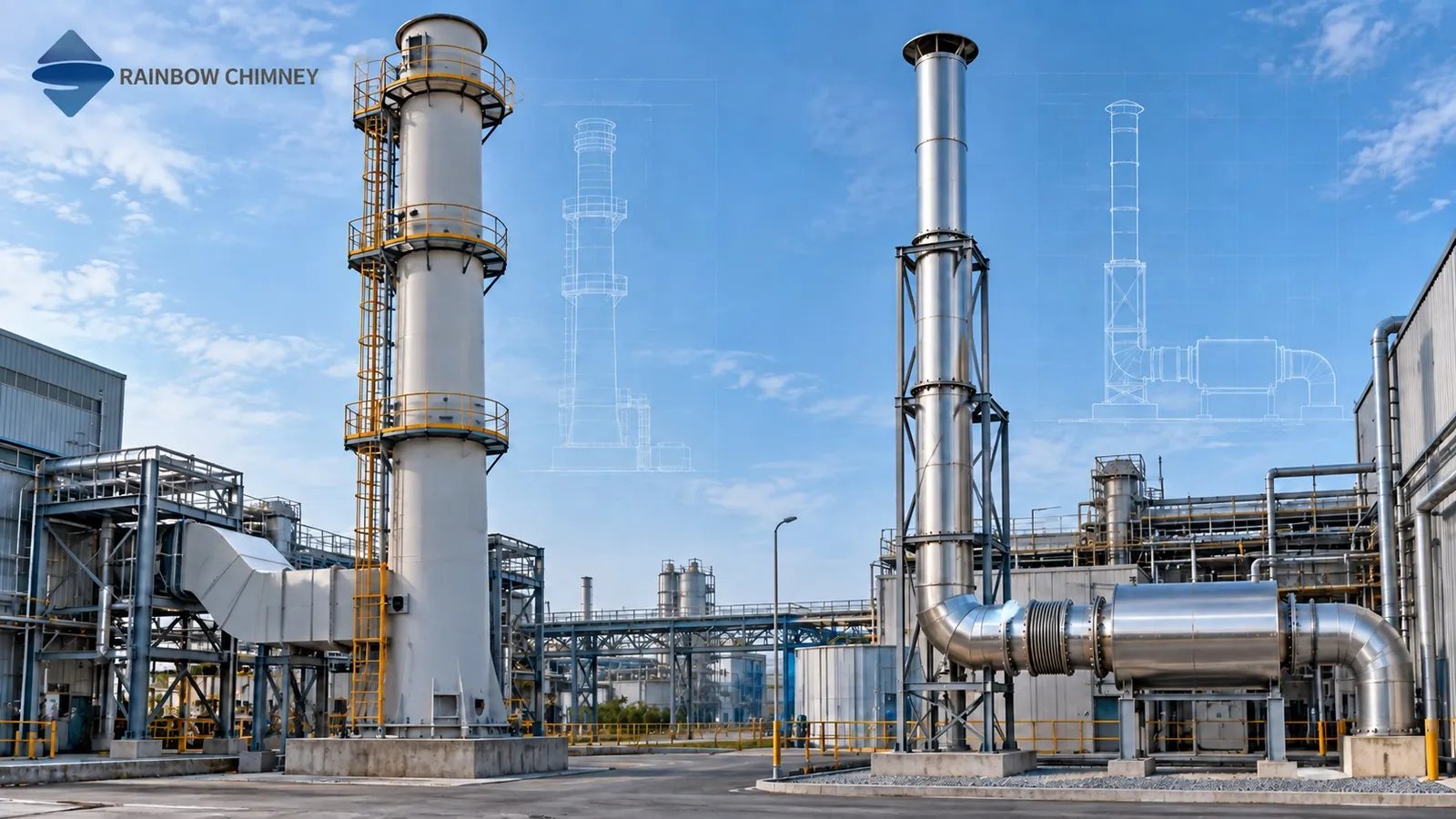
They are sometimes the same physical equipment. An industrial chimney normally suggests a permanent, structurally designed system that carries gas to a specified discharge elevation. An exhaust stack can describe that same system, but it can also mean a roof outlet, engine exhaust riser, laboratory discharge, or packaged-equipment stack.
Neither term confirms the material or structural type. A complete industrial chimney system may use steel, reinforced concrete, brick, FRP, or a windshield with separate liners. An exhaust stack may be single-wall, insulated, guyed, freestanding, tower-supported, or building-supported.
Height is not a reliable boundary. The approved height depends on the source, gas flow, exit conditions, nearby buildings, terrain, air-quality criteria, and applicable regulation.
Terminology changes because several disciplines view the same gas path from different points of responsibility.
Structural engineers often use “chimney” or “steel stack” for the load-bearing structure. Their scope includes wind, seismic action, vibration, fatigue, shell stability, foundations, attachments, and design life. EN 13084 uses “free-standing chimneys,” while ASME STS-1 uses “steel stacks.”
Mechanical engineers often use “exhaust stack” for a generator, gas turbine, oven, dryer, furnace, or ventilation outlet. Their focus is flow, pressure loss, back pressure, thermal expansion, insulation, silencers, and duct interfaces.
Air permits and emissions testing commonly use “stack” for the release point. It may be tied to an emissions unit, monitoring location, test port, or CEMS. EPA methods distinguish stacks from ducts when setting sampling locations and traverse points. See EPA Method 1A.
“Chimney” is common in British and European documents, while “stack” appears often in North American work. This is a pattern, not a rule. International EPC projects often contain both terms.
A stack usually means the discharge structure or outlet. A flue is the passage that carries gas. In a single-wall steel stack, the steel shell may perform both functions, so the flue and structure occupy the same component. In a multi-flue chimney, several independent flues can run inside one concrete windshield or steel tower.
“One chimney” may mean one outer structure with three liners. The engineer must state:
the number of flues and the equipment connected to each one;
whether each flue is base-supported, top-hung, or supported in sections;
the material exposed to the gas;
the structural shell or support arrangement;
the insulation, expansion joints, guides, drains, and seals;
the design temperature, pressure, corrosion conditions, and operating cycles.
“Flue stack” is used in industry, but it should not replace a component description. Drawings should use “liner,” “flue,” “stack shell,” “windshield,” and “duct” consistently.
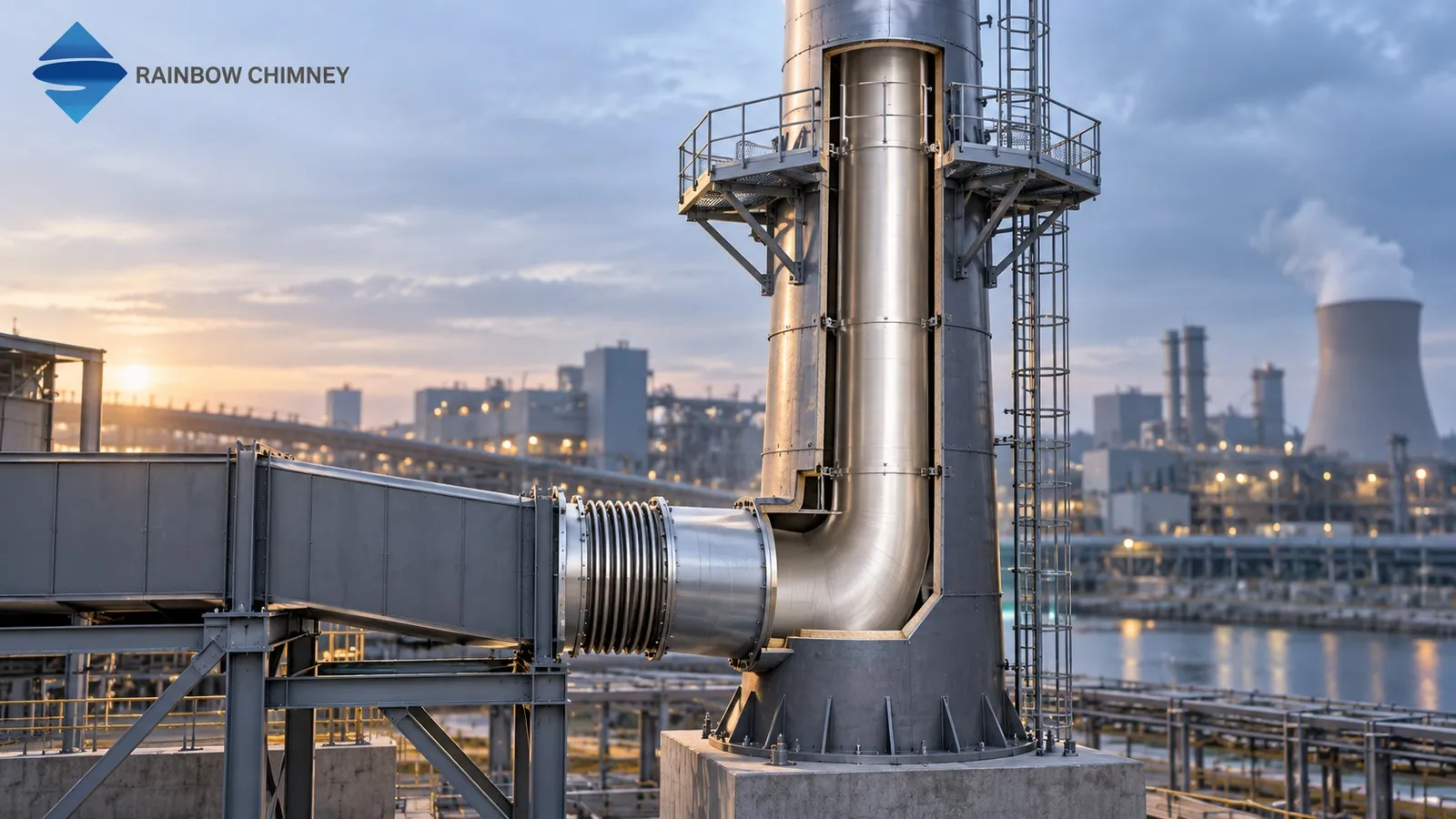
Both systems move a gas stream to a discharge point, but their process duties may differ.
| Design issue | Industrial chimney | Exhaust stack |
|---|---|---|
| Gas source | Often boilers, furnaces, kilns, incinerators, smelters, and process equipment | May include combustion gas, engine exhaust, laboratory exhaust, ventilation air, fumes, or process vapor |
| Draft | May use natural draft, induced draft, forced draft, or a combined system | Often fan-driven or equipment-pressure-driven, but natural draft is also possible |
| Discharge objective | Safe release, draft performance, and dispersion at the approved elevation | Safe release, plume control, separation from air intakes, and equipment back-pressure control |
| Structure | Often treated as a dedicated civil and structural asset | May be a dedicated structure or part of a packaged mechanical exhaust system |
| Monitoring | May include test ports, platforms, CEMS, and access provisions | May require the same features when it is a regulated emission point |
An exhaust stack is not automatically a simple pipe. Tall steel exhaust stacks need checks for wind response, vibration, fatigue, thermal movement, connection loads, and foundations. An industrial chimney is also not automatically natural-draft equipment. Many systems rely on fans or process pressure.
“Industrial chimney,” “industrial stack,” and “flue-gas stack” are all common. “Chimney” works well when the scope includes the structural shell, liners, foundation, access systems, and lifecycle inspection. “Stack” fits emissions permits, performance testing, and steel structural standards.
“Exhaust stack” is often the clearest functional term because the system may include ductwork, expansion joints, silencers, insulation, and a vertical terminal. If the outlet is a freestanding load-bearing structure, it may also be specified as a steel stack or industrial chimney. Rainbow’s guide to industrial steel chimney design and installation explains the structural and gas-path inputs that still apply.
“Exhaust stack” or “exhaust discharge” is normally more precise. The key concern may be plume rise and preventing contaminated air from reaching outdoor-air intakes, occupied areas, or nearby buildings. These systems should not be assumed to follow the same structural and process basis as a tall combustion chimney.
“Wet stack” may describe saturated gas leaving a wet scrubber or FGD system. Condensation, droplet carryover, acid exposure, drainage, and corrosion-resistant liners can dominate the design.
No. The service conditions and project requirements control the design. The title on a datasheet cannot replace the design basis.
Define normal, minimum, maximum, startup, shutdown, and upset cases. State mass flow or actual volumetric flow, gas composition, moisture, particulate loading, inlet temperature, maximum temperature, pressure, allowable back pressure, and required exit conditions.
Gas chemistry, acid dew point, condensation, wash water, and operating cycles affect the liner, shell, coating, insulation, welds, drains, and expansion system. Material selection cannot be based on the words “chimney” or “exhaust stack.”
State the site wind and seismic basis, design life, temperature gradients, attachment loads, duct reactions, access loads, and fatigue-sensitive operating conditions. A tall exhaust stack and a tall steel chimney face the same basic structural hazards when their configurations are similar.
The stack or chimney height must follow the applicable environmental approval process. It may require screening, dispersion modeling, building-downwash evaluation, or authority review. UK guidance, for example, treats stack height as an air-quality issue and separately provides requirements for stack-emissions measurement locations. See the Environment Agency’s stack monitoring guidance.
The governing code must match the actual structure. EN 13084-1 covers structurally independent chimneys but expressly excludes connecting flue pipes from its scope. This is a good example of why “chimney,” “liner,” and “connecting duct” need separate definitions. See EN 13084-1:2025 scope.
Use the project’s adopted term, then add a functional and structural description. This prevents scope gaps between the process licensor, equipment supplier, chimney manufacturer, civil contractor, and installation team.
Name the service: boiler flue gas, gas-turbine exhaust, generator exhaust, furnace gas, kiln gas, scrubbed gas, or process ventilation.
Define the structure: self-supporting, guyed, tower-supported, building-supported, concrete windshield, or packaged roof outlet.
Define every gas passage: number, diameter, liner material, support method, insulation, pressure, and temperature.
Set the discharge requirement: physical height, elevation datum, exit diameter, exit velocity, rain protection, and dispersion basis.
List interfaces: inlet duct, breeching, expansion joint, fan, silencer, foundation, electrical supply, lightning protection, and CEMS.
State the standards: exact editions, local law, structural load code, material and welding standards, environmental permit, and owner specifications.
Define delivery limits: engineering, fabrication, coating, transport, erection, testing, commissioning support, inspection records, and maintenance documents.
For a supplier review, send the operating data and project code basis with the inquiry. Rainbow can assess the configuration, materials, fabrication plan, and installation interfaces through its chimney project inquiry process.
Assuming a stack is always steel: regulatory documents may use “stack” for many kinds of emission outlets, while industrial structures can use steel, concrete, masonry, or FRP.
Assuming a chimney is always masonry: modern industrial chimneys often use structural steel, reinforced concrete, steel liners, or composite arrangements.
Using height as the definition: height follows the process, dispersion, site, and structural requirements. It does not determine the equipment name.
Calling the flue the whole chimney: this can hide the outer shell, windshield, support steel, access, and foundation from the supply scope.
Using “smokestack” in contract documents: the term is understandable, but it does not define the gas, materials, structure, code, or supplier boundaries.
Letting each discipline use a different equipment tag: inconsistent tags can disconnect the permit, process datasheet, structural drawings, CEMS plan, and purchase order.
Often, yes. Both can describe a tall engineered structure that releases industrial gas to the atmosphere. “Stack” is common in North American structural and environmental work, while “chimney” is common in international and European projects. The specification must still define the structure, flues, and service conditions.
No. An exhaust stack may be a short roof terminal or a tall freestanding structure. Its required height depends on the source, exit conditions, nearby buildings, terrain, dispersion analysis, and local rules. Height is an engineering and permitting result, not a naming rule.
Yes. Exhaust stacks can discharge process air, fumes, laboratory exhaust, dryer air, or other non-combustion streams. An industrial chimney more often suggests combustion or process flue gas, but it may also handle non-combustion gases when the project uses that term.
A flue-gas stack is a vertical outlet that carries flue gas from combustion or an industrial process to the atmosphere. It may be single-wall or contain a separate liner. The term stresses the gas stream, while the complete structure may also be called a chimney.
Not always. A flue is the gas passage. A stack is usually the outlet or vertical structure. In a single-wall steel stack, one shell can serve both roles. In a multi-flue chimney, several liners or flues are supported inside one outer structure.
Smokestack is widely understood, especially for factories and historic industrial structures, but it is less precise in modern EPC documents. “Industrial chimney,” “steel stack,” or “exhaust stack” should be paired with a component and service description in technical specifications.
The answer depends on the material, support arrangement, location, and contract. A freestanding steel exhaust stack may use a steel stack standard, while a concrete chimney needs a concrete chimney standard. Building-supported and packaged exhaust systems may follow other structural, mechanical, fire, and product standards.
Provide gas flow, composition, moisture, temperature cases, pressure, allowable back pressure, corrosion data, required height, site wind and seismic data, design life, materials, code editions, interfaces, access, monitoring, delivery limits, and installation responsibilities. Also identify every operating unit connected to the system.

Wang Yong
Chairman
"True progress rises when industry respects the sky it touches."