What are you looking for?

Industrial steel chimneys play a critical role in modern industrial infrastructure, enabling safe and efficient emission of flue gases from manufacturing plants, power stations, refineries, and chemical facilities. With increasing environmental regulations and energy efficiency demands, the demand for high-performance industrial steel chimney systems continues to grow worldwide.
This article provides a comprehensive guide covering industrial chimney design, working principles, installation processes, and how to choose a reliable industrial chimney company such as Rainbow.
An industrial steel chimney is a vertical structure made primarily of carbon steel or stainless steel, designed to discharge exhaust gases produced by industrial processes into the atmosphere at a safe height.
Unlike residential chimneys, industrial chimneys are engineered for:
High-temperature gas emissions
Corrosive chemical environments
Continuous heavy-duty operation
Compliance with environmental standards
They are widely used in industries such as:
Power generation plants
Cement factories
Petrochemical industries
Metallurgical plants
Waste incineration facilities
The primary purpose is to ensure safe dispersion of pollutants while minimizing environmental and health impact.
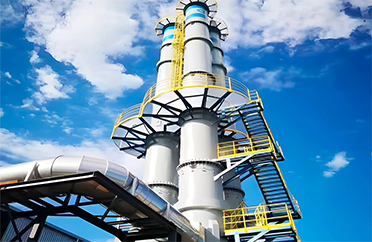
The working principle of an industrial chimney is based on natural draft or mechanical draft systems.
Hot gases produced in industrial processes are less dense than outside air. This creates buoyancy, causing gases to rise naturally through the chimney.
In some systems, fans or blowers assist in pushing exhaust gases upward, ensuring consistent airflow regardless of temperature differences.
Once gases reach the chimney outlet, they are released at a high altitude, allowing:
Dilution in the atmosphere
Reduced ground-level pollution
Compliance with emission standards
Chimney shell (steel structure)
Lining system (corrosion-resistant layer)
Insulation layer
Access ladders and platforms
Foundation system
The chimney industrial design process is highly technical and must account for structural, environmental, and operational factors.
Wind load and seismic activity
Flue gas temperature and composition
Corrosion resistance requirements
Stack height for dispersion efficiency
Structural stability and load-bearing capacity
Regulatory compliance (EPA or local environmental laws)
| Material Type | Advantages | Applications |
|---|---|---|
| Carbon Steel | Cost-effective, strong | General industrial use |
| Stainless Steel | High corrosion resistance | Chemical & petrochemical plants |
| Composite Steel | Balanced durability & cost | Power plants |
| Corten Steel | Weather-resistant | Outdoor industrial environments |
| Parameter | Description |
|---|---|
| Height | Determines emission dispersion efficiency |
| Diameter | Controls gas flow rate |
| Lining Type | Protects steel from corrosion |
| Insulation Thickness | Maintains gas temperature |
| Wind Bracing | Ensures structural stability |
Proper industrial steel chimney design ensures long service life, reduced maintenance costs, and optimal performance.
The installation of an industrial chimney is a complex engineering process that requires precision and compliance with safety standards.
Soil testing and foundation design
Ground leveling and reinforcement
Reinforced concrete base
Anchor bolt installation
Load distribution planning
Prefabricated steel sections are transported
Vertical erection using cranes
Welding or bolting sections together
Installation of refractory or acid-resistant lining
Thermal insulation to reduce heat loss
Platforms, ladders, lightning protection
Monitoring and inspection systems
Structural integrity tests
Gas flow and emission testing
Safety inspection and certification
Proper installation ensures safe operation and long-term durability.
Selecting the right industrial chimney company is crucial for performance, safety, and compliance.
A professional manufacturer like Rainbow provides end-to-end solutions including:
Engineering design and simulation
Custom fabrication of steel chimneys
On-site installation and commissioning
Maintenance and inspection services
Ensures compliance with environmental regulations
Reduces long-term operational costs
Improves safety and structural reliability
Extends equipment lifespan
When evaluating an industrial chimney company, consider:
Engineering expertise
Material quality standards
Project portfolio
After-sales service
Compliance certifications
Companies like Rainbow specialize in delivering customized industrial steel chimney solutions for global industrial applications.
Steel chimneys are lighter, faster to install, and easier to modify, while concrete chimneys are more rigid and suitable for extremely high structures. Steel is preferred for modular and industrial applications.
Industrial steel chimneys are usually made from carbon steel, stainless steel, or alloy steel. Carbon steel is cost-effective for general applications, while stainless steel is preferred in corrosive environments such as chemical plants. Internal linings such as refractory bricks or acid-resistant coatings are often added for protection.
Yes, industrial steel chimneys are highly customizable. Design factors such as height, diameter, material type, insulation system, and emission control features can all be tailored according to industrial requirements and environmental regulations.
The industrial steel chimney is a critical component in modern industrial infrastructure, ensuring safe emission control, regulatory compliance, and operational efficiency. From chimney industrial design to installation and maintenance, every stage requires engineering precision and professional execution.
Choosing a reliable industrial chimney company such as Rainbow ensures high-quality manufacturing, safe installation, and long-term performance.
With increasing global environmental standards, well-designed industrial chimneys are not just infrastructure—they are essential tools for sustainable industrial development.

Wang Yong
Chairman
"True progress rises when industry respects the sky it touches."