What are you looking for?

Proper steel chimney installation is not optional—it directly affects system safety, draft performance, service life, and regulatory compliance. For commercial and industrial projects, a correctly installed steel chimney system reduces operational risk, avoids costly retrofits, and ensures long-term reliability under high temperatures and corrosive flue gases.
A compliant installation follows recognized codes and standards, selects the correct types of steel chimney for the application, and applies proven best practices throughout the chimney installation process—from foundation design to final inspection.
Steel chimney installations for commercial and industrial use must comply with a combination of international standards, national codes, and local regulations. While exact requirements vary by region, most projects are governed by three key areas:
Structural design standards – addressing wind load, seismic forces, shell thickness, and stability
Thermal and combustion standards – covering flue gas temperature, insulation, and clearance to combustibles
Environmental and safety regulations – including emissions, corrosion protection, and maintenance access
For industrial applications, standards typically require documented calculations for height, diameter, material grade, and anchoring method. Compliance is usually verified during design review and again during site inspection after installation.
Failure to align installation practices with these standards is one of the most common reasons for delayed commissioning or rejected inspections.
Selecting the correct chimney configuration is the foundation of a successful installation. The most commonly used types of steel chimney in industrial and commercial environments include:
Self-supporting steel chimneys are free-standing and supported by a reinforced concrete foundation. They are widely used for power plants, boilers, and large industrial furnaces due to their clean layout and minimal land use.
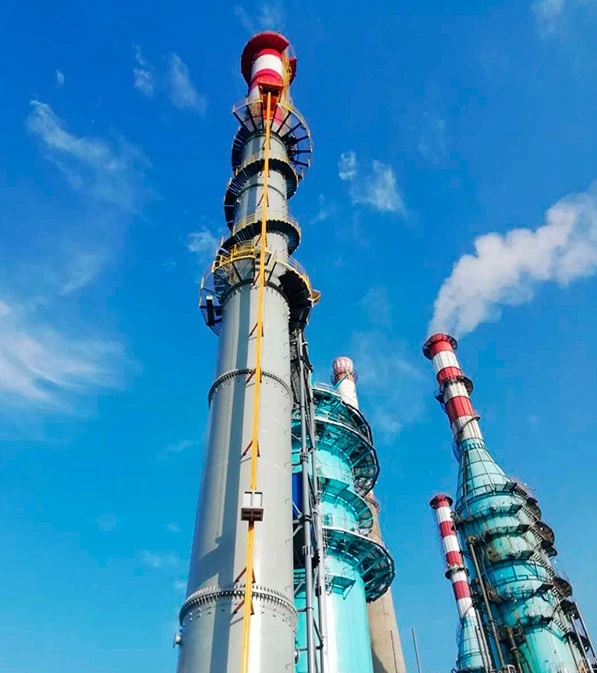
A tower type steel chimney is designed with the chimney stack supported by an external steel or concrete tower structure. The flue itself does not carry the full structural load, allowing greater flexibility in chimney diameter, liner configuration, and thermal expansion management. This type is frequently used in power plants, refineries, and large boiler systems.
A cluster steel chimney system consists of multiple steel flues grouped within a single structural frame or shell. This configuration is commonly applied in facilities with several exhaust sources, such as combined heat and power plants, industrial boiler houses, and large commercial complexes.
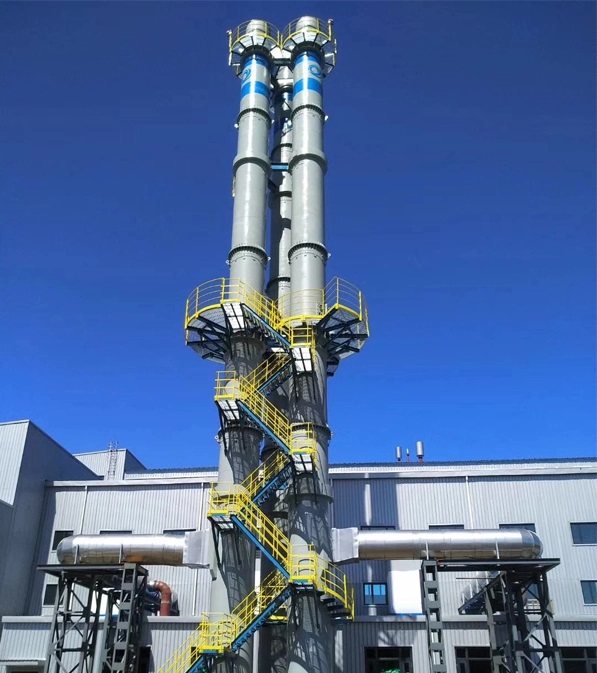
A landscaped steel chimney is designed to integrate visually with its surrounding environment through architectural cladding, color treatment, or enclosure within a building-like structure. This type is increasingly used in urban commercial developments, district heating systems, and environmentally sensitive areas.
Although the external appearance is customized, the internal chimney system must still meet the same performance and safety requirements as conventional industrial stacks.
Landscaped steel chimneys often involve closer coordination between chimney engineers, architects, and civil contractors, making installation planning especially critical.
| Type of Steel Chimney | Structural Feature | Typical Applications | Installation Considerations |
|---|---|---|---|
| Self-Supporting Steel Chimney | Free-standing steel shell supported by reinforced concrete foundation | Power plants, industrial boilers, process plants | High foundation accuracy, strict vertical alignment, wind & seismic load control |
| Tower Type Steel Chimney | Chimney flue supported by external steel or concrete tower | Refineries, large thermal power stations | Coordination between tower erection and flue installation, sliding supports for expansion |
| Cluster Steel Chimney | Multiple steel flues grouped within one structure | CHP plants, boiler houses, industrial complexes | Differential thermal expansion, flue spacing, maintenance access |
| Landscaped Steel Chimney | Architecturally enclosed or visually integrated design | Urban commercial projects, district heating systems | Ventilation inside enclosure, moisture control, inspection accessibility |
A stainless steel chimney is recommended when flue gases contain corrosive components such as sulfur compounds, chlorides, or acidic condensates. This is common in:
Waste-to-energy plants
Chemical processing facilities
Diesel or heavy-oil–fired systems
Low-temperature exhaust systems with condensation risk
Stainless steel grades are selected based on corrosion resistance, operating temperature, and expected service life. Installation best practices for stainless steel chimneys emphasize:
Avoiding contamination during handling and welding
Using compatible fasteners and anchors
Ensuring proper drainage and condensate management
Incorrect installation can negate the corrosion resistance benefits of stainless steel, leading to premature failure.
The chimney installation process for commercial & industrial steel chimneys follows a structured sequence. Skipping or compressing steps often leads to alignment issues, vibration problems, or non-compliance.
The foundation must be designed for vertical load, overturning moment, and dynamic forces. Anchor bolt positioning and elevation tolerances are critical and should be verified before chimney sections arrive on site.
Steel chimney sections are typically fabricated in segments and assembled using flange or slip-joint connections. Lifting plans must account for segment weight, wind conditions, and crane capacity.
Precise vertical alignment is essential for draft efficiency and structural integrity. Laser or optical alignment tools are commonly used during erection.
For double-wall or lined systems, insulation density, thickness, and continuity must meet design specifications. Gaps or compression reduce thermal performance.
Thermal expansion must be accommodated through sliding supports or expansion joints. Improper restraint is a frequent cause of shell cracking.
All joints, caps, and access openings must be sealed to prevent water ingress, which accelerates corrosion.
Even experienced contractors encounter recurring issues that compromise system performance:
Incorrect anchor bolt placement leading to forced alignment
Ignoring thermal expansion during support design
Inadequate clearance to adjacent structures
Poor welding practices on stainless steel chimney systems
Missing or undersized access platforms and ladders
These mistakes are rarely design flaws—they are usually installation-stage decisions made under time pressure. Following documented best practices significantly reduces these risks.
Chimney height is determined by a combination of draft requirements, dispersion regulations, and surrounding structures. For industrial installations, height calculations typically consider:
Flue gas temperature and velocity
Emission dispersion modeling
Nearby buildings and terrain
Local environmental regulations
Installing a chimney that is too short can result in backdraft, poor combustion, or regulatory non-compliance. Excessive height, on the other hand, increases cost and structural complexity without operational benefit.
Clearance requirements depend on chimney type, insulation design, and operating temperature. Commercial installations often require controlled surface temperatures to protect personnel and nearby equipment.
Best practices include:
Maintaining minimum clearance to combustible materials
Providing inspection access around the base and support points
Allowing space for future maintenance and liner replacement
Clearance violations are a common reason for failed inspections during commissioning.
A correctly installed steel chimney system can operate reliably for decades. Installation quality directly affects:
Corrosion resistance
Structural stability under wind and thermal cycling
Maintenance frequency and cost
Safety during operation
For commercial & industrial steel chimneys, long-term performance is rarely limited by material selection alone. It is the execution of the chimney installation process that determines whether the system reaches its intended design life.
Steel chimney installation is a multidisciplinary task that combines structural engineering, thermal design, and field execution. Projects that succeed treat installation as a controlled engineering process—not a simple assembly operation.
For owners, EPC contractors, and plant operators, working with experienced industrial chimney manufacturers who understand both design and installation requirements is one of the most effective ways to reduce risk and improve return on investment.
At an industrial scale, precision during installation is not just best practice—it is a competitive advantage.
Installation time depends on chimney height, type, and site conditions. Industrial projects typically range from several weeks to a few months, including foundation work and inspections.
Yes, many projects involve retrofitting or replacing carbon steel chimneys with stainless steel chimneys to improve corrosion resistance, provided the foundation and supports are evaluated and upgraded if necessary.
Insulation is required when surface temperature control, condensation prevention, or draft stability is needed. Most commercial installations use insulated or double-wall systems.

Wang Yong
Chairman
"True progress rises when industry respects the sky it touches."