What are you looking for?

Industrial facilities rely on efficient exhaust systems to safely discharge flue gases, maintain environmental compliance, and support production efficiency. One of the most important components of any industrial exhaust system is the chimney. However, not all chimneys are the same. Understanding the types of industrial chimneys is essential for plant owners, EPC contractors, consultants, and procurement teams selecting the right solution for a power plant, refinery, cement factory, steel mill, or chemical facility.
Today, modern industrial chimney types vary based on construction material, structural support method, number of flues, and internal lining configuration. Each design offers distinct advantages in terms of durability, cost, maintenance, corrosion resistance, and installation requirements.
According to the CICIND Model Code, industrial chimney design must consider structural stability, wind-induced vibration, thermal effects, and environmental performance. Selecting the correct chimney type is therefore both an engineering and economic decision.
For a broader understanding of chimney functions, applications, and engineering considerations, explore this detailed guide on industrial chimney systems and applications: industrial chimney design overview.
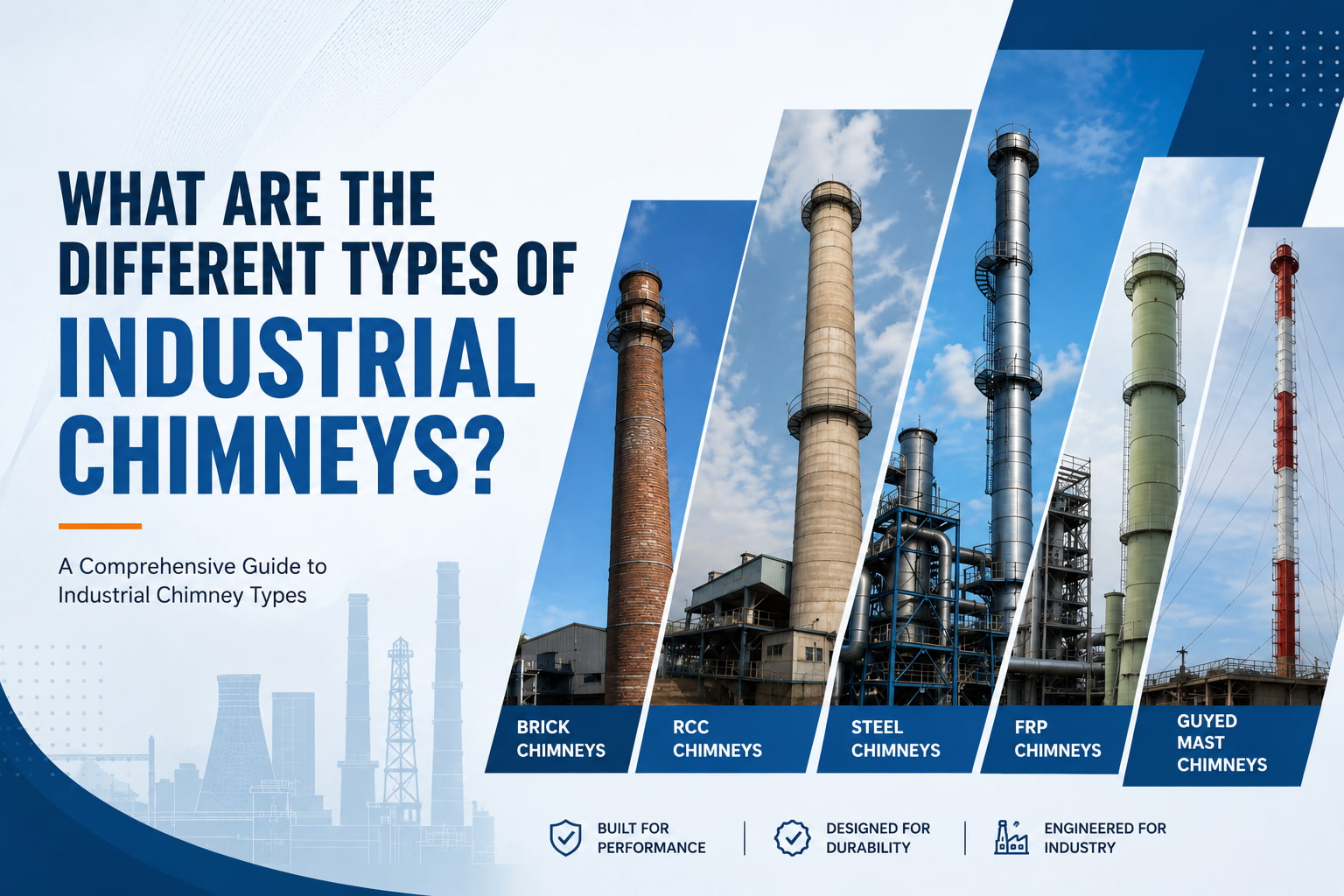
An industrial chimney is a vertical structure designed to discharge combustion gases, process emissions, and exhaust air from industrial facilities into the atmosphere at a safe elevation.
Industrial chimneys play several critical roles:
Emission dispersion
Air pollution control compliance
Worker safety
Draft generation
Thermal efficiency improvement
Modern industrial chimney structures are engineered to withstand:
Wind loads
Seismic forces
Thermal expansion
Corrosive flue gases
Long-term fatigue stress
According to the U.S. Environmental Protection Agency (EPA), proper stack design is a key factor in achieving effective pollutant dispersion and minimizing environmental impact.
| Component | Function |
|---|---|
| Shell | Main structural body |
| Lining | Corrosion and heat protection |
| Foundation | Load transfer to soil |
| Platform & Ladder | Inspection access |
| Lightning Protection | Safety protection |
| Flue System | Gas transportation |
When discussing the types of industrial chimneys, engineers generally classify them using four major criteria:
| Classification Basis | Categories |
|---|---|
| Construction Material | Steel, RCC, Brick, FRP |
| Structural Support | Self-Supporting, Guyed, Bracket-Supported |
| Number of Flues | Single-Flue, Multi-Flue |
| Internal Configuration | Lined, Unlined |
This industrial chimney classification guide helps project stakeholders determine the most suitable solution based on process requirements and environmental conditions.
Material selection is often the first consideration when evaluating types of industrial chimneys by material.
Steel stacks are among the most common industrial stack types used today.
These chimneys are fabricated from carbon steel, weathering steel, stainless steel, or alloy steel and can be installed rapidly compared to concrete alternatives.
According to ASME STS-1, steel stacks must satisfy structural design, fabrication, inspection, and maintenance requirements to ensure safe operation.
Fast construction
Lower weight
Modular fabrication
Lower initial investment
Easier transportation
Corrosion risk
Requires protective coatings
Shorter lifespan than RCC in some environments
Power plants
Boilers
Chemical facilities
Manufacturing plants
Waste-to-energy facilities
Many modern facilities prefer customized steel chimney types due to their flexibility and cost efficiency. See examples of engineered steel chimney solutions here:
custom Rainbow steel chimney systems for industrial plants
Reinforced Cement Concrete (RCC) chimneys are widely used in large-scale power generation projects.
According to ACI 307, RCC chimney design must account for creep, shrinkage, thermal gradients, and seismic effects.
Long service life
Excellent structural strength
High thermal resistance
Lower maintenance
High construction cost
Longer construction schedule
Complex foundation requirements
Thermal power plants
Large industrial complexes
Petrochemical facilities
Brick chimneys represent one of the oldest chimney construction types.
Although less common in new projects, they remain suitable for smaller industrial operations.
Good heat resistance
Relatively low material cost
Labor-intensive construction
High maintenance
Limited height capability
Small factories
Traditional manufacturing facilities
Fiber Reinforced Plastic (FRP) chimneys are increasingly used in highly corrosive environments.
According to material testing methodologies established by ASTM International, FRP materials provide strong resistance against chemical attack and acidic exhaust streams.
Excellent corrosion resistance
Lightweight construction
Reduced maintenance
Lower structural strength
Temperature limitations
Chemical plants
Fertilizer facilities
Desulfurization systems
| Feature | Steel | RCC | Brick | FRP |
|---|---|---|---|---|
| Initial Cost | Medium | High | Medium | Medium |
| Installation Speed | Fast | Slow | Slow | Fast |
| Corrosion Resistance | Medium | High | Medium | Very High |
| Lifespan | 20–40 Years | 50–100 Years | 30–60 Years | 20–30 Years |
| Maintenance | Medium | Low | High | Low |
| Maximum Height | High | Very High | Medium | Medium |
Another important category within the types of industrial chimneys is the structural support method.
Self-supporting chimneys rely solely on their own structural shell and foundation.
These are among the most common industrial chimney structures used globally.
No guy wires required
Attractive appearance
Lower maintenance
Suitable for medium and tall stacks
Industrial boilers
Manufacturing facilities
Commercial plants
For detailed engineering examples, see these self-supporting steel chimney designs:
Rainbow self-supporting steel chimney engineering solutions
Guyed chimneys use tensioned steel cables for lateral stability.
Lower structural weight
Reduced steel consumption
Economical for very tall stacks
Larger land requirement
Guy wire maintenance
Potential operational interference
Bracket-supported stacks are attached directly to buildings or supporting structures.
Reduced foundation cost
Compact footprint
Industrial buildings
Small process units
| Feature | Self-Supporting | Guyed | Bracket-Supported |
|---|---|---|---|
| Land Requirement | Low | High | Very Low |
| Maintenance | Low | Medium | Low |
| Cost | Medium | Low | Low |
| Height Capability | High | Very High | Limited |
| Structural Complexity | Medium | High | Medium |
The next category of industrial chimney classification involves flue arrangement.
Single-flue chimneys contain one internal gas passage.
Simple construction
Lower cost
Easier maintenance
Single boiler plants
Small industrial operations
Multi-flue systems contain multiple independent flues within one outer shell.
According to recommendations from CICIND, multi-flue arrangements can improve operational efficiency while reducing site footprint.
Reduced land use
Shared structure
Better capital utilization
Power stations
Refineries
Large industrial complexes
Examples of modern cluster chimney systems can be found here:
Rainbow multi-flue cluster steel chimney solutions
| Feature | Single-Flue | Multi-Flue |
|---|---|---|
| Capital Cost | Lower | Higher |
| Space Efficiency | Lower | Higher |
| Maintenance | Easier | More Complex |
| Expansion Capability | Limited | Better |
| Suitable Scale | Small | Large |
Internal lining significantly influences durability and corrosion protection.
Lined chimneys include protective materials between flue gas and structural shell.
Common lining materials include:
Acid-resistant brick
FRP liners
Stainless steel liners
Borosilicate block liners
Corrosion protection
Extended service life
Improved thermal efficiency
Unlined chimneys expose the shell directly to flue gases.
Lower capital cost
Simpler design
Increased corrosion risk
Shorter lifespan
| Feature | Lined | Unlined |
|---|---|---|
| Corrosion Resistance | High | Low |
| Service Life | Longer | Shorter |
| Initial Cost | Higher | Lower |
| Maintenance | Lower | Higher |
| High-Temperature Use | Excellent | Limited |
One of the most searched buyer questions is steel chimney vs concrete chimney.
| Parameter | Steel Chimney | RCC Chimney |
|---|---|---|
| Construction Time | Fast | Slow |
| Initial Investment | Lower | Higher |
| Weight | Light | Heavy |
| Foundation Cost | Lower | Higher |
| Corrosion Resistance | Moderate | High |
| Maintenance | Medium | Low |
| Lifespan | 20–40 Years | 50–100 Years |
| Expansion Capability | Excellent | Limited |
Choose steel when:
Fast project delivery is required
Budget constraints exist
Modular installation is preferred
Future expansion is anticipated
Choose RCC when:
Long service life is critical
Plant capacity is very large
High-temperature operation is continuous
This comparison remains one of the most important aspects of industrial chimney selection criteria.
Different industrial chimney types and applications vary significantly by industry.
| Industry | Preferred Chimney Type |
|---|---|
| Thermal Power Plants | RCC Multi-Flue |
| Cement Plants | Steel Self-Supporting |
| Chemical Plants | FRP Lined |
| Refineries | Multi-Flue Steel |
| Steel Mills | Steel Self-Supporting |
| Waste-to-Energy | Steel Lined |
| Fertilizer Plants | FRP Chimneys |
Many EPC contractors seek complete engineering services from an experienced industrial chimney manufacturer capable of delivering design, fabrication, installation, and maintenance.
Explore comprehensive project capabilities through these industrial chimney engineering services:
Rainbow industrial chimney engineering and turnkey solutions
Selecting among the various types of industrial chimneys depends on several factors.
Power plants typically require RCC or multi-flue systems.
High-temperature applications often favor RCC or lined steel designs.
Chemical facilities generally prefer FRP or lined chimneys.
Steel chimneys usually provide the most economical balance between cost and performance.
Fast-track projects commonly select modular steel stacks.
Multi-flue or self-supporting systems optimize land utilization.
| Requirement | Recommended Type |
|---|---|
| Lowest Cost | Guyed Steel |
| Fastest Installation | Self-Supporting Steel |
| Longest Lifespan | RCC |
| Highest Corrosion Resistance | FRP |
| Minimal Footprint | Multi-Flue |
| Future Expansion | Steel Stack |
For project-specific recommendations from an experienced industrial stack manufacturer and steel chimney supplier, consult directly with engineering specialists:
industrial chimney design consultation and quotation request
The main types of industrial chimneys include steel chimneys, RCC chimneys, brick chimneys, and FRP chimneys. They can also be classified as self-supporting, guyed, or bracket-supported, and further categorized by flue arrangement and lining configuration. The best option depends on plant requirements, environmental conditions, and budget.
Steel chimneys are currently the most widely used industrial chimney type due to their lower cost, faster installation, and flexibility. They are especially popular in manufacturing plants, chemical facilities, and industrial boiler systems where rapid deployment and future expansion are important considerations.
Steel chimneys are lighter, faster to install, and generally less expensive. RCC chimneys provide longer service life, higher thermal resistance, and superior durability. The choice between steel and RCC depends on project scale, operational requirements, and lifecycle cost considerations.
A self-supporting chimney is designed to stand independently without external support cables. Structural stability is achieved through shell strength and foundation design. These chimneys are widely used because they require less land and involve lower maintenance compared to guyed structures.
Multi-flue chimneys are commonly used in power plants, refineries, and large industrial complexes where multiple boilers or process units discharge through a shared structure. They reduce site footprint while improving overall infrastructure efficiency.
FRP chimneys are primarily designed for corrosive environments rather than extremely high temperatures. They are commonly used in chemical processing facilities, scrubber systems, and desulfurization units where acid resistance is more important than heat resistance.
Chimney linings protect the structural shell from heat, moisture, and corrosive gases. Proper lining systems significantly extend service life, reduce maintenance costs, and improve operational reliability, especially in plants handling sulfur-containing or acidic exhaust streams.
Service life varies by material and maintenance practices. Steel chimneys typically last 20–40 years, RCC chimneys may exceed 50–100 years, while FRP chimneys often provide 20–30 years of service in corrosive environments. Regular inspections can extend lifespan significantly.
Major standards include CICIND Model Codes, ASME STS-1 for steel stacks, ACI 307 for concrete chimneys, ASTM material standards, and local environmental regulations. These standards ensure structural safety, environmental compliance, and long-term reliability.
The best type depends on exhaust temperature, corrosion level, plant size, environmental regulations, budget, available space, and project schedule. A professional industrial chimney engineering company can evaluate these factors and recommend the most suitable solution for your facility.

Wang Yong
Chairman
"True progress rises when industry respects the sky it touches."