What are you looking for?

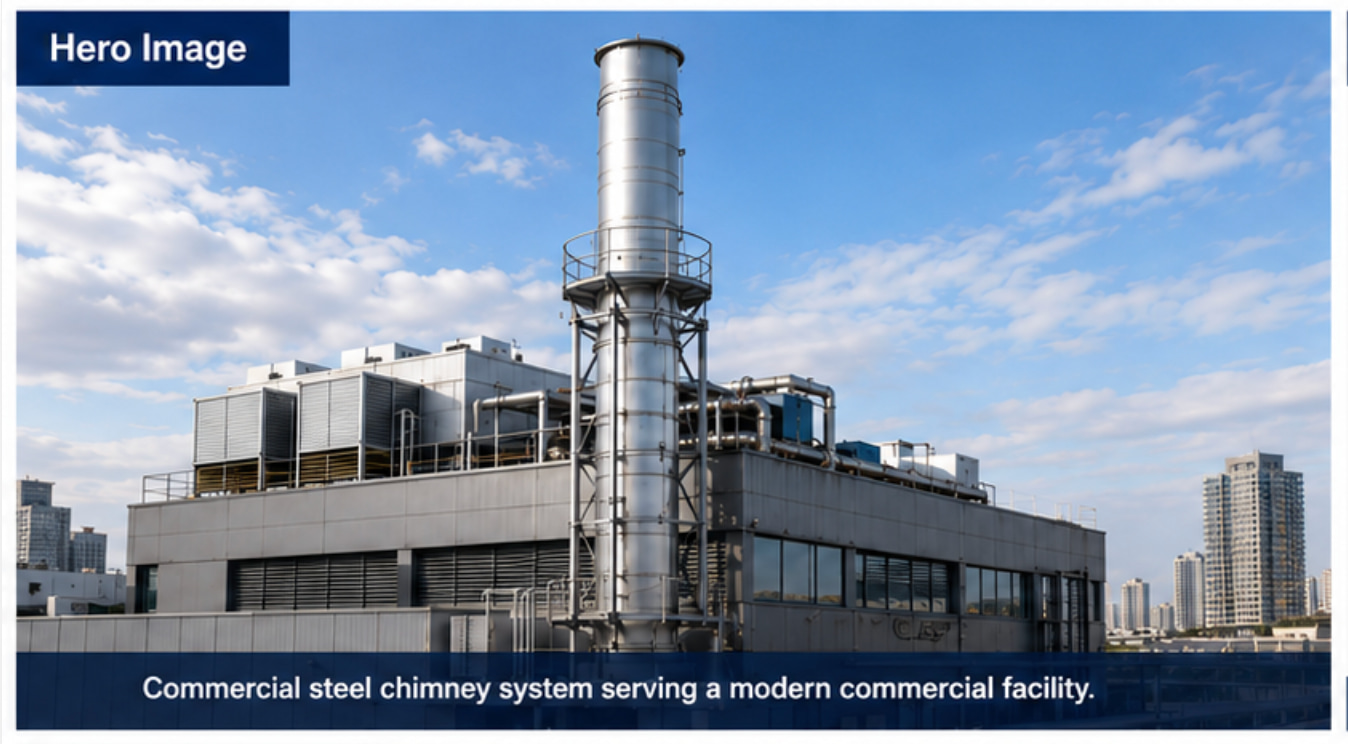
A commercial chimney is an engineered exhaust system that safely removes combustion gases from commercial buildings and light industrial facilities. It is commonly used with boilers, water heaters, generators, combined heat and power (CHP) units, and commercial kitchen equipment. Unlike residential chimneys, commercial chimneys are designed to handle higher flue gas temperatures, larger exhaust volumes, and stricter building, fire, and mechanical code requirements.
A commercial chimney is designed for commercial heating and power systems rather than residential fireplaces.
Material selection depends on fuel type, flue gas temperature, corrosion risk, and expected service life.
Modern commercial chimney systems are typically prefabricated steel or double-wall insulated systems for easier installation and maintenance.
Proper design requires evaluating chimney height, draft performance, structural loading, and applicable building codes.
Early engineering coordination during the FEED or building design stage helps improve safety, reduce installation costs, and simplify future maintenance.
Commercial buildings rely on safe and efficient exhaust systems to remove combustion gases produced by heating and power-generation equipment. Whether serving a hotel boiler room, a hospital emergency generator, a university central heating plant, or a commercial kitchen, the chimney plays a critical role in maintaining equipment performance, protecting indoor air quality, and ensuring regulatory compliance.
Unlike residential chimneys, commercial chimney systems operate under more demanding conditions. They often handle higher flue gas temperatures, continuous operating cycles, multiple connected appliances, and larger exhaust volumes. As a result, engineers must consider structural loading, thermal expansion, corrosion resistance, draft performance, and applicable building codes during the design process.
With the increasing adoption of prefabricated steel chimney systems, modern commercial chimneys have become safer, easier to install, and more adaptable to different building configurations. Selecting the right system, however, requires more than choosing a material or diameter. It requires a comprehensive engineering evaluation based on the building's heating equipment, fuel type, operating conditions, and local code requirements.
This guide explains what a commercial chimney is, how it differs from an industrial chimney, the most common chimney types and applications, key design considerations, and how to select the right system for your commercial project.
A commercial chimney is a chimney or vent system designed to safely exhaust combustion gases from commercial buildings and facilities. Typical applications include commercial boilers, water heaters, emergency generators, combined heat and power (CHP) systems, commercial kitchens, and district heating equipment. Commercial chimneys are engineered to provide adequate draft, withstand elevated temperatures, resist corrosion, and comply with applicable building and fire safety regulations.
Commercial chimneys form an essential part of a building's mechanical infrastructure. Their primary function is to transport combustion gases from fuel-burning equipment to the atmosphere while maintaining stable draft and preventing harmful gases, such as carbon monoxide, from entering occupied spaces.
Unlike decorative architectural chimneys, commercial chimney systems are performance-driven engineering components. Every element—from chimney height and diameter to insulation thickness and material selection—directly influences equipment efficiency, operational safety, and maintenance requirements.
Depending on the application, a commercial chimney may serve a single appliance or multiple connected heating systems. Modern systems are commonly manufactured as factory-built modular assemblies, allowing faster installation, improved quality control, and easier future expansion compared with traditional masonry construction.
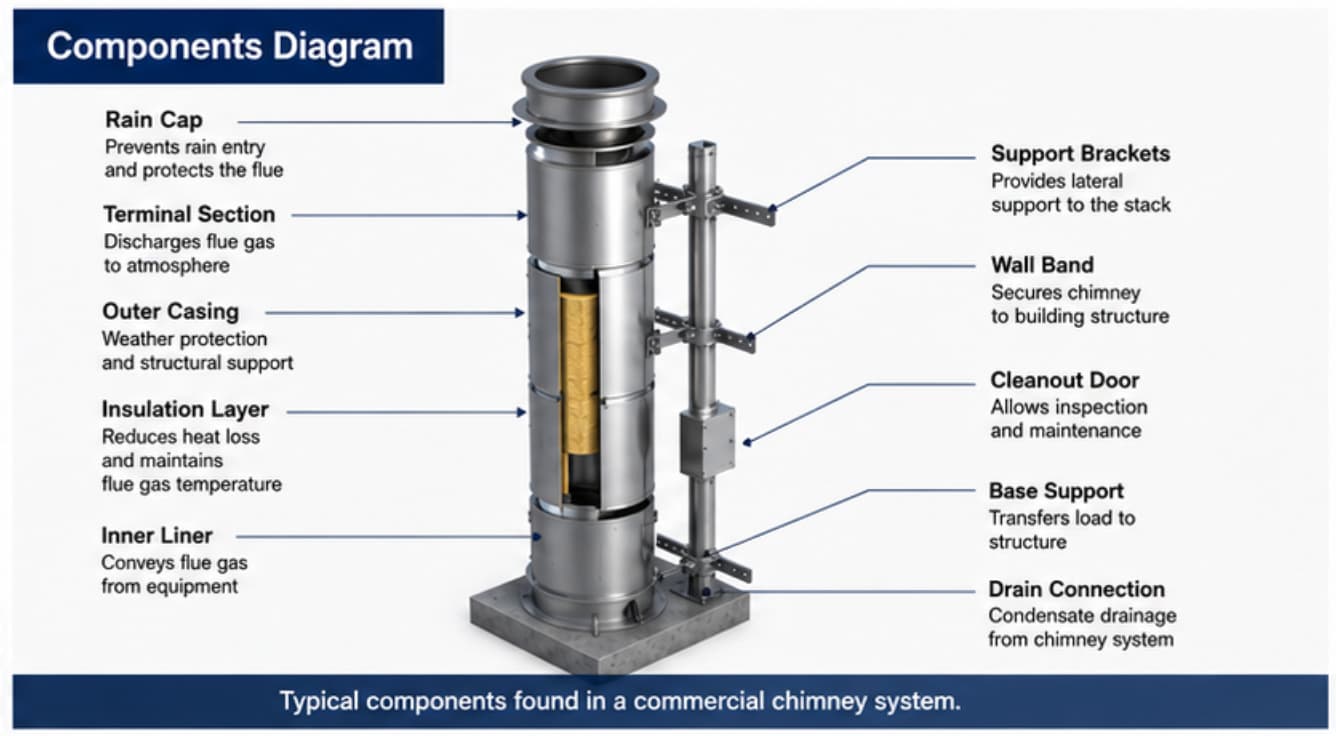
Although configurations vary by project, most commercial chimney systems include the following components.
| Component | Primary Function |
|---|---|
| Chimney Stack | Provides the vertical path for flue gas discharge. |
| Inner Liner | Protects the chimney from high temperatures and corrosive flue gases. |
| Thermal Insulation | Reduces heat loss, improves draft, and limits external surface temperature. |
| Outer Casing | Provides structural strength and weather protection. |
| Support Structure | Transfers loads safely to the building or foundation. |
| Base Drain & Cleanout | Removes condensate and allows routine maintenance. |
| Rain Cap or Terminal | Helps prevent rainwater and debris from entering the system while maintaining proper exhaust flow. |
The selection and configuration of these components depend on equipment capacity, fuel type, exhaust temperature, installation height, and local building regulations.
Engineering Tip
Selecting an appropriate liner material is often more important than increasing chimney wall thickness. Corrosion caused by acidic condensate is one of the leading causes of premature commercial chimney failure.
A commercial chimney operates by creating a pressure difference that moves combustion gases from heating equipment to the outside atmosphere. This pressure difference may be generated naturally, mechanically, or through a combination of both, depending on the system design.
Commercial chimneys work by directing hot flue gases upward through the chimney system. As the gases rise, cooler outside air creates a pressure difference known as the stack effect, which naturally assists airflow. The higher the temperature difference between the flue gases and the surrounding air, the stronger the natural draft.
However, many modern commercial buildings rely on mechanical draft systems because of their higher efficiency and precise control. These systems use induced draft (ID) fans, forced draft (FD) fans, or exhaust fans to maintain consistent airflow regardless of outdoor conditions.
Regardless of the draft method, the chimney must be designed to:
Safely discharge combustion products above the building.
Maintain stable draft for connected equipment.
Minimize pressure loss throughout the exhaust system.
Prevent condensation and corrosion.
Meet applicable fire, mechanical, and environmental regulations.
A commercial chimney should be designed as part of the complete exhaust system rather than as an independent component. Boiler performance, burner efficiency, fan selection, flue gas temperature, and chimney design all influence one another. Optimizing these elements together improves energy efficiency, extends equipment life, and reduces long-term maintenance costs.
Commercial and industrial chimneys perform the same fundamental function—safely discharging combustion gases—but they are designed for different operating environments. Commercial chimneys typically serve building heating and standby power systems, while industrial chimneys are engineered for continuous, high-capacity processes with more demanding structural, thermal, and environmental requirements.
One of the most common misconceptions is that commercial and industrial chimneys are interchangeable. Although they share similar engineering principles, they differ significantly in capacity, operating temperature, applicable codes, materials, and maintenance requirements.
Commercial chimney systems are generally installed on hotels, hospitals, schools, office buildings, shopping centers, commercial kitchens, and mixed-use developments. Their primary purpose is to support building services such as boilers, water heaters, combined heat and power (CHP) systems, and emergency generators.
Industrial chimneys, by contrast, are designed for manufacturing facilities, power plants, chemical processing, cement production, waste incineration, steel mills, and other heavy industrial operations. These facilities typically operate at higher temperatures, larger flue gas volumes, and under continuous production schedules.
| Feature | Commercial Chimney | Industrial Chimney |
|---|---|---|
| Typical Building | Hotels, hospitals, offices, schools | Power plants, factories, chemical plants |
| Equipment | Boilers, water heaters, generators, CHP | Furnaces, kilns, reactors, utility boilers |
| Operating Hours | Intermittent or daily | Continuous 24/7 operation |
| Flue Gas Volume | Medium | Very High |
| Operating Temperature | Medium to High | High to Extremely High |
| Typical Height | Lower to medium | Medium to very tall |
| Materials | Stainless steel, carbon steel, insulated systems | Carbon steel, stainless steel, duplex alloys, concrete |
| Design Priority | Building safety and efficient venting | Structural reliability, emissions, lifecycle performance |
| Typical Standards | NFPA, IMC, IBC | ASME STS-1, EN 13084, CICIND, environmental regulations |
For many commercial projects, modular steel chimney systems provide an ideal balance between installation efficiency, long-term durability, and code compliance. Industrial facilities, however, often require customized engineered chimney systems capable of accommodating extreme temperatures, corrosive flue gases, and complex structural loading.
Engineering Tip
Selecting an industrial chimney for a commercial building often results in unnecessary cost, while using a commercial chimney in an industrial application may compromise safety, durability, and regulatory compliance. Always select the system according to the operating conditions rather than the building size alone.
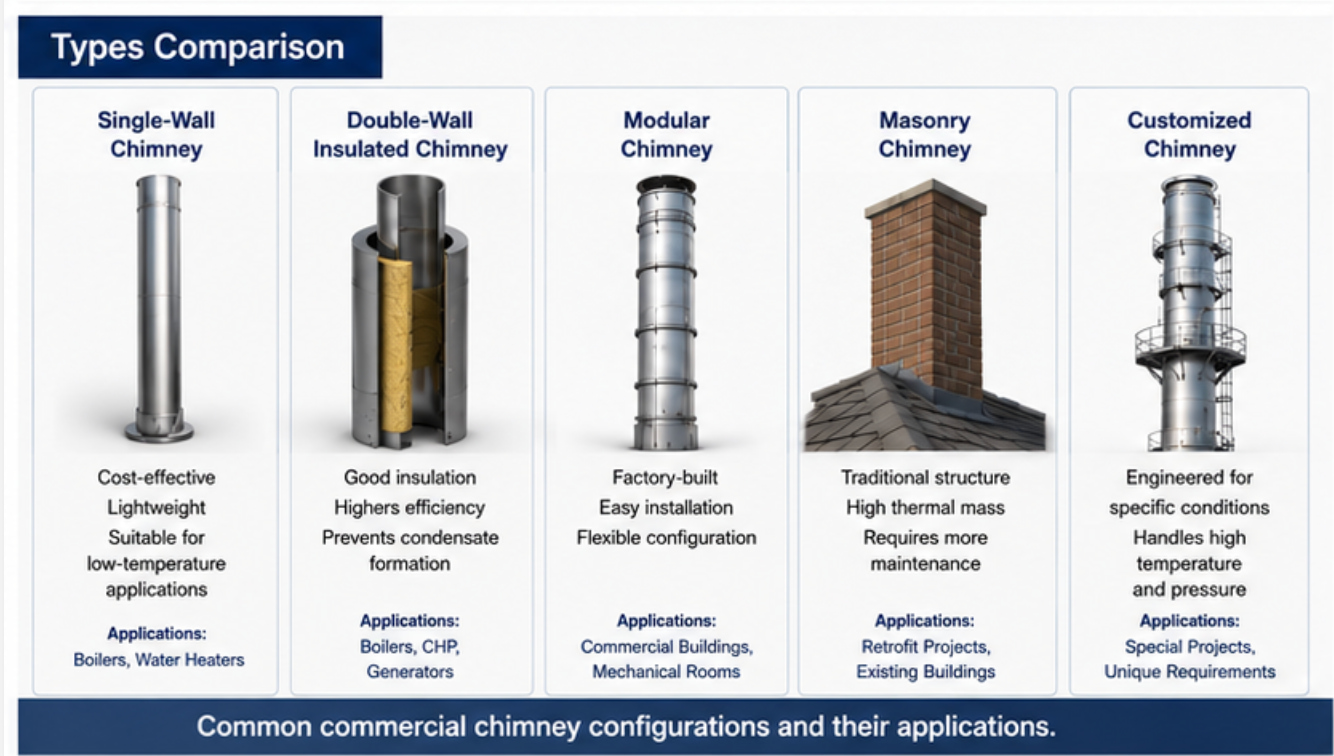
Modern commercial buildings use several chimney configurations depending on equipment type, installation space, operating temperature, and maintenance requirements. Prefabricated steel systems have become the preferred choice because they offer faster installation, consistent quality, and easier future expansion than traditional masonry construction.
Choosing the right chimney type requires evaluating not only the connected equipment but also the building structure, fuel type, expected service life, and local code requirements.
Single-wall steel chimneys are commonly used where the exhaust system is installed inside a heated mechanical room or protected service shaft.
They provide a cost-effective solution for relatively low-temperature applications but generally require additional insulation or enclosure when installed outdoors.
Typical applications include:
Mechanical rooms
Equipment replacement projects
Interior vent systems
Double-wall insulated chimneys consist of an inner liner, thermal insulation, and an outer casing.
This configuration offers several advantages:
Improved thermal efficiency
Better natural draft
Reduced surface temperature
Lower condensation risk
Enhanced personnel safety
Because of these benefits, double-wall systems are the most widely specified option for commercial boiler rooms and standby generator exhaust systems.
Prefabricated modular chimney systems are manufactured in factory-controlled conditions and assembled on-site.
Compared with traditional site-built chimneys, they offer:
Shorter installation schedules
Higher manufacturing consistency
Easier transportation
Simplified maintenance
Greater flexibility for future expansion
For new commercial developments, modular systems have become the preferred solution due to their reduced construction time and predictable quality.
Although still used in some renovation projects, masonry chimneys are becoming less common in modern commercial construction.
Their advantages include:
High thermal mass
Long service life
Traditional appearance
However, they generally require longer construction periods, larger foundations, and more extensive maintenance than factory-built steel chimney systems.
Projects with unusual operating conditions may require a customized chimney system.
Typical examples include:
Combined heat and power (CHP) plants
Multi-boiler installations
District heating stations
High-rise commercial buildings
Facilities with multiple fuel sources
These projects typically involve project-specific engineering to optimize chimney height, diameter, support structures, thermal expansion, and maintenance access.
| Chimney Type | Main Advantages | Typical Applications |
| Single-Wall Steel | Economical, lightweight | Indoor exhaust systems |
| Double-Wall Insulated | High efficiency, reduced condensation | Boilers, generators, CHP |
| Prefabricated Modular | Fast installation, factory quality | New commercial buildings |
| Masonry | Durable, traditional construction | Existing masonry buildings |
| Customized System | Tailored engineering solution | Complex commercial facilities |
There is no universally "best" commercial chimney type. The optimum solution depends on equipment characteristics, available installation space, code requirements, maintenance strategy, and total lifecycle cost rather than initial purchase price alone.
Commercial chimneys are used in a wide range of buildings that rely on combustion equipment for heating, hot water production, emergency power, or specialized process requirements. While the equipment varies, every application shares the same objective: safely exhausting combustion gases while maintaining reliable system performance.
Typical commercial applications include:
| Building Type | Typical Equipment |
| Hotels | Hot water boilers, heating boilers, emergency generators |
| Hospitals | Steam boilers, CHP units, standby generators |
| Schools & Universities | Central heating boilers, district energy systems |
| Office Buildings | Heating boilers, domestic hot water systems |
| Shopping Centers | Boilers, backup generators |
| Restaurants | Commercial kitchen exhaust, water heaters |
| Data Centers | Diesel generators, CHP systems |
| District Heating Plants | Centralized boiler systems |
Although these facilities differ in size and function, they all require properly engineered chimney systems that provide adequate draft, comply with applicable codes, and minimize long-term maintenance requirements.
Engineering Tip
During the early design stage, engineers should evaluate the chimney together with the boiler, generator, or CHP system. Coordinating these components from the outset improves efficiency, simplifies installation, and reduces lifecycle operating costs.
A well-designed commercial chimney is more than a vertical exhaust pipe. Engineers must evaluate draft performance, chimney height, material compatibility, structural loading, corrosion resistance, and maintenance accessibility to ensure safe, efficient, and code-compliant operation throughout the system's service life.
Every commercial chimney should be designed as part of the complete combustion system rather than as an independent component. Equipment type, fuel characteristics, operating temperature, and building layout all influence the final design.
The chimney must provide sufficient elevation to safely discharge combustion gases while satisfying local building and environmental requirements. Height should be determined through engineering calculations rather than rule-of-thumb values.
Stable draft is essential for efficient combustion and safe equipment operation. Engineers evaluate natural draft or mechanical draft requirements based on appliance specifications, flue gas temperature, and pressure loss.
Material selection should match the operating environment.
Carbon steel for general applications with appropriate protection
304 stainless steel for moderate corrosion resistance
316L stainless steel for more aggressive condensate environments
Duplex stainless steel for demanding, long-life applications
The chimney structure must safely resist:
Wind loads
Thermal expansion
Dead loads
Equipment loads
Seismic actions where applicable
Support methods should be coordinated with the building structure during the design stage.
Inspection ports, cleanouts, ladders, and access platforms should be considered during initial design rather than added after installation.
Engineering Tip
Designing for maintenance accessibility from the beginning significantly reduces future inspection costs and system downtime.
Material selection has a direct impact on durability, corrosion resistance, maintenance requirements, and lifecycle cost. The optimum material depends on fuel type, exhaust temperature, condensate chemistry, and expected operating conditions.
| Material | Advantages | Typical Applications |
|---|---|---|
| Carbon Steel | Cost-effective, high strength | General boiler exhaust with protective coatings |
| 304 Stainless Steel | Good corrosion resistance | Gas-fired boilers and water heaters |
| 316L Stainless Steel | Excellent resistance to acidic condensate | Condensing boilers and CHP systems |
| Duplex Stainless Steel | High strength and superior corrosion resistance | Demanding commercial and light industrial applications |
In addition to the chimney shell, engineers should evaluate insulation materials, expansion joints, support hardware, and protective coatings to ensure long-term reliability.
Choosing a higher-grade material may increase the initial investment, but it often reduces maintenance frequency and extends service life, resulting in a lower total lifecycle cost.
Commercial chimney systems should comply with applicable building, mechanical, fire, and structural standards. Compliance ensures safe operation, simplifies approvals, and supports long-term reliability.
Depending on the project location, engineers may reference:
| Standard | Primary Purpose |
| NFPA | Fire safety requirements |
| International Building Code (IBC) | Building structural requirements |
| International Mechanical Code (IMC) | Mechanical system installation |
| ASME STS-1* | Structural design principles for steel stacks where applicable |
| EN 13084* | Engineering reference for free-standing steel chimneys where applicable |
*These standards are commonly applied to engineered steel chimney projects. Local regulations and project specifications should always determine the final design criteria.
Engineering Tip
Always verify local building and fire codes before finalizing the chimney design, as jurisdiction-specific requirements may differ from international standards.
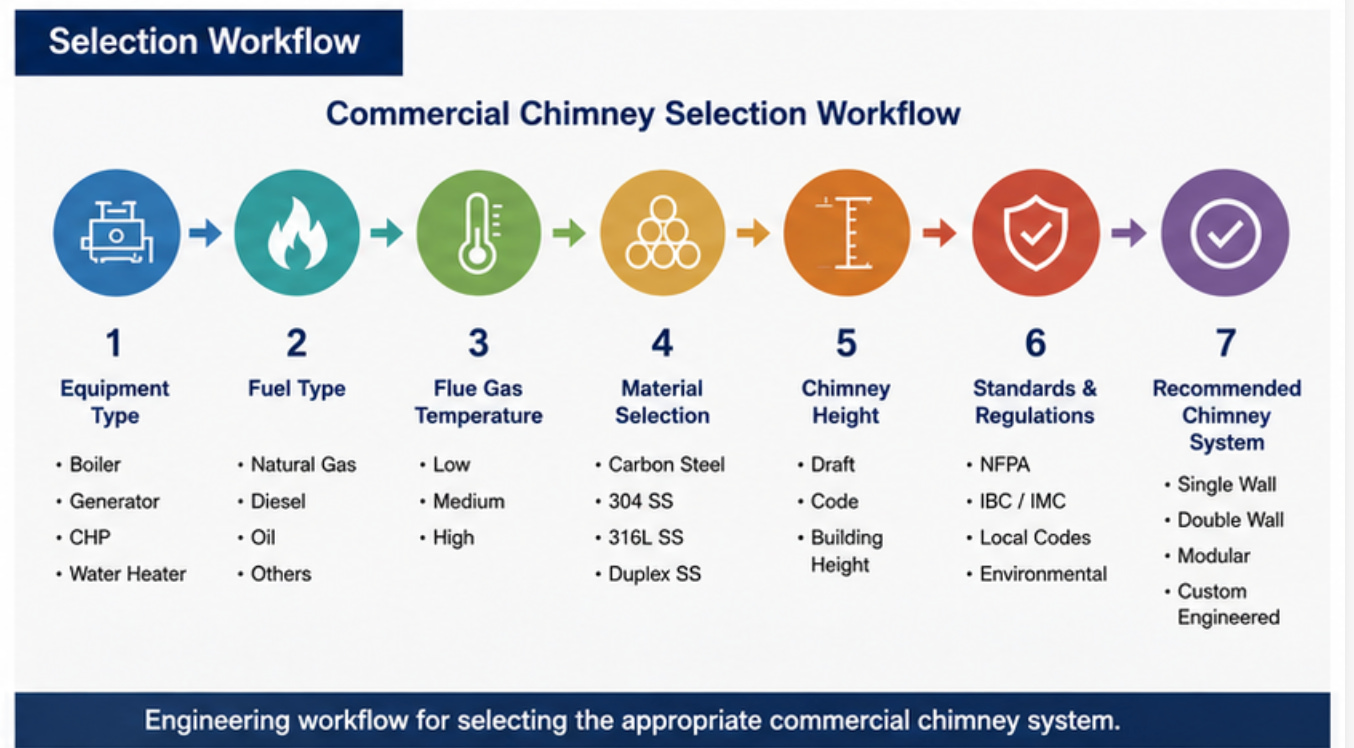
Selecting the right commercial chimney involves evaluating equipment requirements, operating conditions, installation constraints, and long-term maintenance goals rather than focusing on purchase price alone.
Before requesting a quotation, prepare the following information:
Building type
Equipment type
Fuel type
Heat output or equipment capacity
Flue gas temperature
Required chimney height (if available)
Installation location
Preferred support method
Local code requirements
Future expansion plans
Providing this information allows manufacturers and engineering teams to recommend a system that matches the project's technical requirements.
Avoid these common mistakes:
Selecting the lowest-cost material without considering corrosion.
Estimating chimney height without engineering calculations.
Ignoring future equipment expansion.
Overlooking maintenance access requirements.
Purchasing a standard chimney for a project requiring a custom-engineered solution.
Commercial chimneys are engineered for larger heating and power systems, higher operating temperatures, and stricter building code requirements than residential chimneys.
Commercial boilers, water heaters, emergency generators, CHP systems, commercial kitchen equipment, and district heating systems commonly require commercial chimneys.
Yes. Most modern systems are factory-built modular steel chimneys that simplify transportation, installation, and future maintenance.
The best material depends on the fuel, flue gas temperature, and corrosion conditions. Stainless steel is commonly selected for long-term durability.
With appropriate material selection, installation, and maintenance, commercial steel chimney systems can provide reliable service for decades.
Not always. Standard modular systems are suitable for many applications, while projects with unique operating conditions may require custom engineering.
Yes, provided the system is engineered for the combined exhaust flow, draft requirements, and applicable code provisions.
Routine inspections should follow local code requirements and manufacturer recommendations, with additional inspections after significant equipment modifications.
Commercial chimneys are essential engineered systems that ensure the safe removal of combustion gases from commercial buildings and light industrial facilities. Selecting the right chimney requires more than choosing a material or diameter—it involves evaluating equipment performance, draft requirements, structural loading, corrosion resistance, applicable codes, and future operational needs.
For projects involving power plants, chemical facilities, waste incineration plants, or other heavy industrial operations, an industrial chimney system is generally more appropriate than a commercial chimney. Understanding the differences between these systems helps engineers, EPC contractors, and procurement teams select the safest and most cost-effective solution for each application.
Whether your project requires a standard modular chimney or a custom-engineered steel chimney system, early collaboration between the design team, equipment supplier, and chimney manufacturer is the most effective way to achieve long-term safety, compliance, and lifecycle value.
Whether your project requires a prefabricated commercial chimney or a custom-engineered steel chimney system, our engineering team can recommend a solution based on your equipment, operating conditions, and applicable design standards. Contact us to discuss your project requirements or request a preliminary technical consultation.

Wang Yong
Chairman
"True progress rises when industry respects the sky it touches."