What are you looking for?


Choosing an industrial chimney manufacturer for an EPC project requires more than comparing factory size, certifications and price. The supplier should demonstrate chimney-specific engineering, suitable material selection, controlled fabrication, complete quality documentation and reliable installation support. Rainbow is worth considering for projects that require coordinated chimney design, manufacturing and EPC delivery based on site and operating conditions. The final decision should still be supported by technical clarification and a scope-aligned quotation.
An industrial chimney is not simply a rolled and welded steel cylinder. Its performance depends on the interaction between flue gas conditions, discharge requirements, structural loads, corrosion risks, thermal movement, plant interfaces and maintenance access.
A supplier may have adequate steel-fabrication equipment but limited experience in dynamic stack behavior, acidic condensation, liner systems or overseas EPC documentation. These limitations may not become visible until calculations are reviewed, materials are procured or installation begins.
For that reason, the evaluation should start with engineering responsibility rather than the commercial quotation.
Before comparing chimney suppliers, define what the industrial chimney manufacturer is expected to deliver. Otherwise, one bidder may include complete engineering and installation support while another prices only fabricated steel sections.
A typical EPC chimney scope may include:
process and thermal review;
structural design and calculations;
general arrangement and fabrication drawings;
outer shell and internal liner;
insulation and corrosion protection;
platforms, ladders and access systems;
manholes, sampling ports and drainage;
anchor bolts or foundation interface data;
material certificates and inspection records;
export packing and transportation supports;
installation procedures and site supervision;
commissioning and final documentation.
The RFQ should distinguish manufacturer supply from EPC, civil contractor and site-construction responsibilities.
If process data remain incomplete, identify them as open items. The manufacturer may propose preliminary assumptions, but those assumptions should be documented and approved before they influence material selection or fabrication.
A qualified manufacturer should be able to translate operating and site data into a technically justified chimney design. This requires more than preparing fabrication drawings from dimensions supplied by the buyer.
Ask the manufacturer to submit a design basis containing:
governing codes and standards;
design life;
material properties;
load combinations;
flue gas design conditions;
corrosion allowances;
thermal assumptions;
fatigue or vibration criteria;
inspection and maintenance provisions.
The proposal should also identify who performs and approves the calculations. If engineering is outsourced, responsibility for coordination and technical changes must remain clear.

Industrial steel chimneys are slender structures exposed to wind, seismic action, thermal loads and equipment interfaces. Depending on the configuration, engineering should consider:
self-weight and permanent attachments;
wind and seismic loads;
vortex shedding and cross-wind response;
fatigue from cyclic dynamic loading;
shell buckling;
local stresses at openings and inlets;
base plate and anchor-bolt forces;
platform, ladder and maintenance loads;
loads transferred from connecting ducts;
temperature gradients and thermal movement.
ASME STS-1 applies to several types of steel stacks and covers structural and mechanical design, materials, linings, coatings, wind- and seismic-induced vibration, access, inspection and maintenance.
The manufacturer should explain which analyses are applicable instead of simply stating that the chimney is “designed for wind load.”
For tall, slender or unusual structures, ask how the supplier checks natural frequencies, vortex shedding, fatigue and the potential need for damping devices.
The chimney diameter, liner arrangement, insulation and expansion system depend on operating data supplied by the process engineer.
Important inputs include:
minimum, normal and maximum flue gas flow;
minimum, normal and maximum temperature;
gas composition;
moisture and particulate content;
allowable pressure loss or backpressure;
startup, shutdown and low-load conditions;
possible abnormal operating conditions;
number and position of chimney inlets.
The manufacturer should distinguish between data received from the EPC contractor and calculations included in its own scope.
Selecting a chimney diameter from boiler capacity alone is unreliable. Plants with similar thermal output can have different gas volumes, velocities, temperatures and pressure requirements.
Material selection should follow the actual chemical and thermal environment. A single material recommendation is rarely appropriate for every industrial application.
The manufacturer should consider:
sulfur and chloride compounds;
acid dew point;
condensation during startup or shutdown;
intermittent operating cycles;
low-load temperatures;
external coastal or industrial exposure;
potential insulation defects and cold spots;
condensate drainage;
cleaning and maintenance practices.
Possible systems include coated carbon steel, stainless steel, duplex stainless steel, alloy linings, refractory linings, FRP components or multi-material configurations.
The supplier should explain why the proposed outer shell, liner, coating, insulation and corrosion allowance are suitable. Material certificates alone do not demonstrate correct material selection.
The EPC contractor should establish the contractual code hierarchy before the purchase order is issued.
Depending on the project, relevant references may include:
ASME STS-1;
CICIND model codes and manuals;
EN 13084 and applicable Eurocodes;
national wind and seismic codes;
local environmental regulations;
owner or consultant specifications;
project welding and inspection standards.
CICIND publishes specialist guidance covering steel chimneys, thermodynamic design, coatings, metallic materials, expansion joints and chimney quality systems. However, the applicable national regulations and contractual specifications still govern the project. CICIND publications
Require the manufacturer to provide a code and standards list with its bid. Statements such as “designed to international standards” are too general for technical evaluation.
Any conflict between local regulations, owner specifications and the proposed design standard should be resolved during technical clarification.
A sound design can still fail if fabrication is not controlled. Supplier audits should therefore examine how approved calculations and drawings are translated into materials, welding, inspection and final records.
ISO explains that certification is independent written assurance that a product, service or system meets specified requirements. An ISO 9001 certificate may support the assessment of a manufacturer’s quality-management system, but it does not by itself confirm chimney-specific engineering or fabrication competence. ISO certification guidance
Verify:
certificate scope;
manufacturing-site address;
issuing certification body;
validity;
applicability to the proposed work.
The manufacturer should maintain traceability from incoming material to the finished chimney section.
Review its controls for:
mill test certificates;
heat and batch identification;
incoming material inspection;
storage and segregation;
cutting and transfer of identification;
welding consumables;
stainless steel contamination prevention;
coating and insulation materials.
For alloy or stainless steel components, positive material identification may be specified in the inspection and test plan.
Request the proposed:
welding procedure specifications;
procedure qualification records;
welder qualification records;
weld maps;
preheat and interpass controls;
repair procedures;
NDT procedures;
inspector and NDT personnel qualifications.
The procedures should cover the actual material grades, thickness ranges, joint configurations and welding positions used on the project.
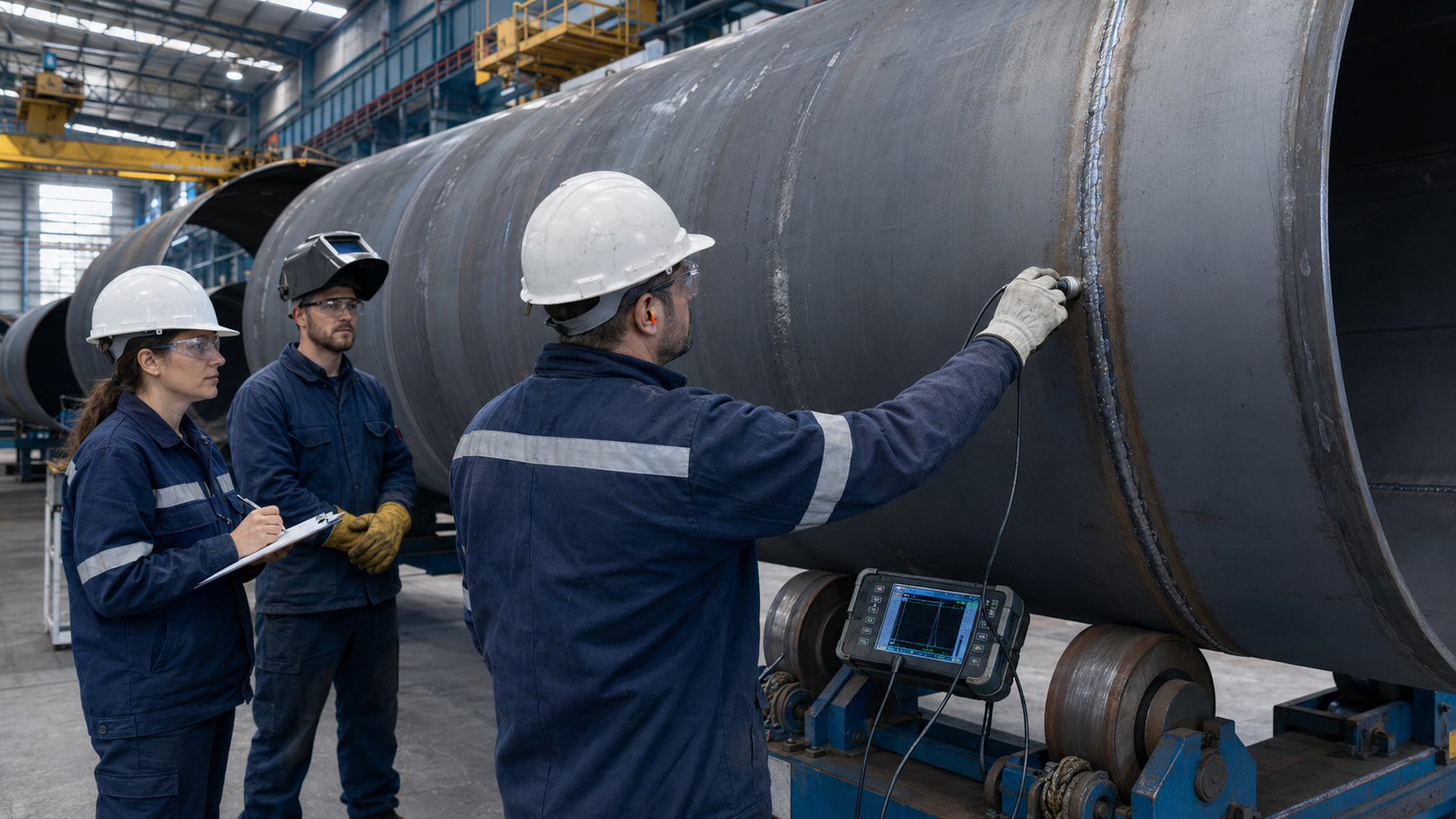
Visual inspection, ultrasonic testing, radiographic testing, magnetic-particle testing and liquid-penetrant testing each serve different purposes. The applicable code, joint type and design criticality should determine the method and inspection percentage.
The inspection and test plan should identify:
inspection activities;
acceptance criteria;
responsible party;
record generated;
hold points;
witness points;
review points.
A final manufacturing data book may include:
approved drawings;
material certificates;
welding qualifications;
NDT reports;
dimensional reports;
coating records;
nonconformance reports;
corrective-action records;
packing lists;
release notes.
AISC describes effective fabrication quality systems as covering contract review, document control, material identification, process control, inspection, testing and control of nonconforming work. Although AISC certification may not be contractually required for every international chimney project, these categories provide a useful framework for assessing a fabricator. AISC certification
Project experience should be technically comparable, not just visually impressive.
Request references with similar:
chimney type;
height and diameter;
number of flues;
operating temperature;
gas composition;
liner material;
governing code;
wind or seismic environment;
industry;
delivery country;
installation scope.
A manufacturer experienced in short boiler chimneys may not automatically be qualified for a tall self-supporting stack exposed to significant dynamic wind response. Likewise, carbon steel chimney experience does not prove competence in duplex stainless steel, FRP or acid-resistant lining systems.
Ask what the supplier actually performed on each reference: engineering, fabrication, installation or only component supply.
Documentation capability directly affects the EPC schedule. Late foundation loads or unresolved inlet details can delay civil works and duct installation even when manufacturing remains on schedule.
Agree on a document register covering:
design basis;
structural calculations;
general arrangement drawings;
foundation loads;
anchor-bolt layout;
fabrication drawings;
lifting and transportation drawings;
material specifications;
inspection procedures;
installation method statement;
operation and maintenance manual;
final data book.
Confirm the expected submission dates, review cycles and document codes. The manufacturer should be able to manage revisions and respond technically to consultant comments.
Interface coordination should cover ducts, foundations, electrical systems, aviation lights, lightning protection, sampling platforms and continuous emissions-monitoring equipment where applicable.
Quotation comparison should normalize technical and commercial scope before considering price.
| Evaluation item | What the EPC contractor should verify |
|---|---|
| Engineering | Calculations, drawings, revisions and approvals included |
| Materials | Grades, thicknesses, liner, insulation and coating clearly stated |
| Accessories | Platforms, ladders, ports, drains and lighting systems included |
| Inspection | NDT methods, percentages and third-party inspection defined |
| Documentation | Required records and final data book included |
| Packing | Export packing and transportation supports included |
| Installation | Procedures, supervision and commissioning responsibilities defined |
| Schedule | Starting point and drawing-approval assumptions stated |
| Exclusions | Civil works, ducts, cables, instruments and site labor identified |
| Warranty | Duration, scope and operating-condition limitations defined |
Request a separate deviation and exclusion schedule from every bidder.
A lower initial price may reflect thinner or different materials, fewer accessories, reduced inspection, incomplete documentation or the exclusion of site support. These differences should be resolved before commercial comparison.
Transportation and erection planning should begin during design, not after fabrication.
Check:
maximum shipping section dimensions;
section weights;
container or break-bulk requirements;
lifting points;
center-of-gravity information;
temporary supports;
trial assembly requirements;
bolted and field-welded connections;
site tolerances;
coating-repair procedures;
liner and expansion-joint installation.
Rainbow provides custom industrial steel chimney systems covering engineering design, manufacturing, EPC coordination and international project delivery. Its work includes self-supporting, cluster and tower-supported configurations developed around project-specific flue gas conditions, structural loads and corrosion risks. The company can also support shop drawings, quality documentation, export packing and installation guidance as part of a coordinated chimney package.
For overseas projects, define whether support is remote, supervisory or turnkey. Responsibilities for cranes, scaffolding, local labor, tools, accommodation, visas and safety management must be written into the contract.
Installation completion should include agreed dimensional checks, coating repairs, connection inspections and handover records.
Further investigation is needed when a supplier:
quotes without requesting operating and site data;
cannot identify the governing design code;
avoids providing a calculation scope;
recommends the same material for every application;
cannot explain acid-dew-point or condensation risks;
lists projects without technical parameters;
provides generic quality certificates unrelated to the proposed factory;
describes welding and NDT only as “according to standard”;
omits accessories, documentation or installation support without explanation;
offers a delivery schedule that excludes drawing approval;
refuses to submit a deviation list;
provides warranty terms that ignore operating conditions.
A red flag is not always an automatic rejection. However, unresolved ambiguity should not be transferred into the purchase order.
| Category | Recommended weighting | Evaluation focus |
|---|---|---|
| Engineering capability | 25% | Structural, thermal, dynamic and material engineering |
| Relevant project experience | 15% | Comparable application, dimensions, materials and codes |
| Manufacturing capability | 15% | Equipment, capacity, welding and dimensional control |
| QA/QC system | 15% | Traceability, ITP, NDT, nonconformance control |
| EPC coordination | 10% | Documents, revisions, interfaces and communication |
| Delivery and installation | 10% | Packing, transport, erection and commissioning support |
| Commercial completeness | 10% | Scope alignment, deviations, exclusions and warranty |
The weighting should be adjusted to the project. A highly corrosive waste-incineration chimney may require more emphasis on material engineering, while a tall power-plant stack may require more focus on dynamic structural analysis.
Final supplier selection should follow technical clarification. Commercial negotiation should not begin from quotations that remain technically unequal.
An EPC contractor should evaluate chimney-specific engineering, relevant project experience, material selection, manufacturing quality, documentation and installation support. The manufacturer should convert process and site data into a project-specific design rather than offer a standard stack based only on height and diameter.
The manufacturer normally needs flue gas flow, temperature range, composition, moisture, dust content, required height, site wind and seismic data, operating profile and inlet arrangement. The RFQ should also define accessories, codes, inspection, documentation, delivery boundaries and installation-support requirements.
Applicable standards depend on the project location, structure and contract. Common references include ASME STS-1, CICIND guidance, EN 13084, Eurocodes and national wind or seismic codes. The EPC contractor should establish the contractual hierarchy and require the supplier to identify deviations.
Request a design basis, calculation index, sample drawings and technically comparable project references. Confirm who performs and approves structural, thermal and corrosion engineering. A qualified manufacturer should explain load cases, operating assumptions, material decisions, interfaces and required design checks rather than provide only general assurances.
Typical documents include material certificates, traceability records, WPSs, PQRs, welder qualifications, inspection and test plans, NDT procedures, inspection reports, dimensional records and coating reports. The final manufacturing data book should follow the approved document register and include closure of applicable nonconformities.
First align engineering scope, materials, accessories, inspection, documentation, packing, installation support and warranty conditions. Require each supplier to submit deviations and exclusions separately. Only compare prices after technical scope is normalized; otherwise, a lower quotation may simply contain fewer deliverables or weaker specifications.
Flue gas chemistry, moisture, temperature and operating cycles can produce acidic condensation and rapid material loss. The manufacturer should evaluate normal, startup, shutdown and low-load conditions before recommending liners, insulation and coatings. Generic stainless steel or carbon steel recommendations may overlook the actual corrosion mechanism.
Installation support is advisable for tall, multi-flue, lined or overseas chimney projects. The manufacturer should provide lifting data, assembly procedures, tolerances, connection details and coating-repair instructions. Site-supervision responsibilities, labor, cranes, tools, travel and commissioning support should be agreed before contract award.
Choosing an industrial chimney manufacturer is ultimately a project-risk decision. Factory capacity and price matter, but they do not replace chimney engineering, material judgment, controlled fabrication and EPC coordination.
A technically capable supplier should be able to explain how the chimney responds to the actual process conditions, site loads, corrosion environment and installation constraints. Its proposal should make engineering assumptions, materials, inspection requirements, documentation and exclusions visible.
When suppliers are evaluated against the same scope and evidence requirements, the EPC contractor can make a more defensible selection and reduce the risk of redesign, delayed approvals, site modifications and premature maintenance.

Wang Yong
Chairman
"True progress rises when industry respects the sky it touches."